Your AI isn't broken. Your business is.
MIT says 95% of enterprise AI pilots fail. Gartner names poor data quality first. RAND says the cause is not the technology. The floors below are missing.

I keep hearing the same sentence: we tried AI, it did not work, it is overhyped. And when I look under the hood of the failed attempt, I find the same thing almost every time. The AI was fine. The three floors underneath it were never built. And the industry sold you the top floor anyway.
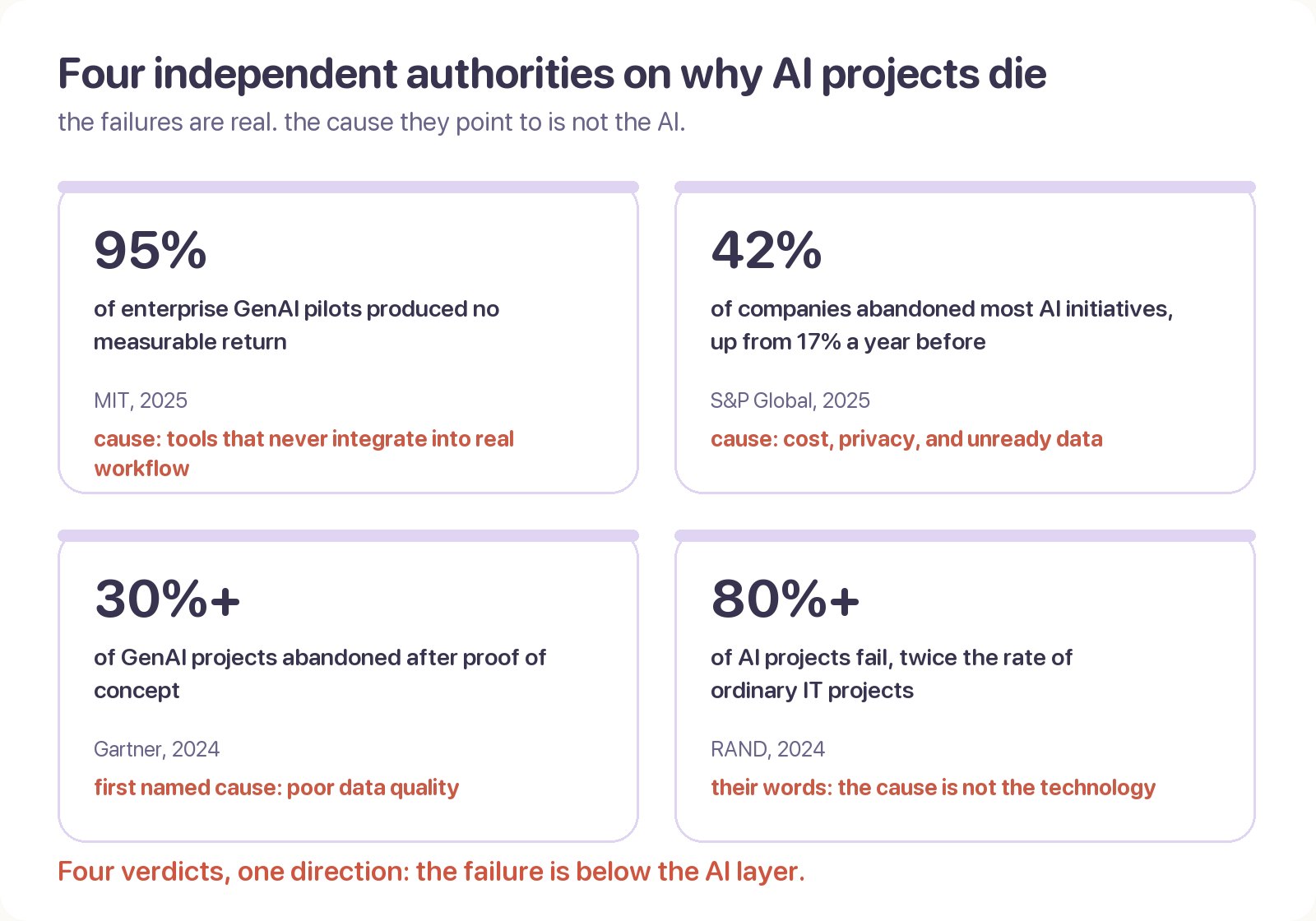
The numbers behind that observation are stark. MIT found that 95% of enterprise generative-AI pilots produced no measurable return. S&P Global found the share of companies abandoning most of their AI initiatives jumped from 17% to 42% in a single year. Gartner predicted at least 30% of projects would die after proof of concept, and the first cause it named was poor data quality. RAND put overall AI project failure above 80% and wrote, in as many words, that the most common cause is not the technology.
Four independent authorities, one direction: the failure lives below the AI layer. This essay is about what actually sits down there, in three floors, and why the unglamorous work of building them is where the durable money is.
What are the three floors?
Digitization, then automation, then intelligence, in that order, with no skipping. I learned this the slow way across a decade of enterprise data work and a year of building AI agents with my own hands, and it is the single most useful model I know for why AI succeeds in one business and faceplants in the next.
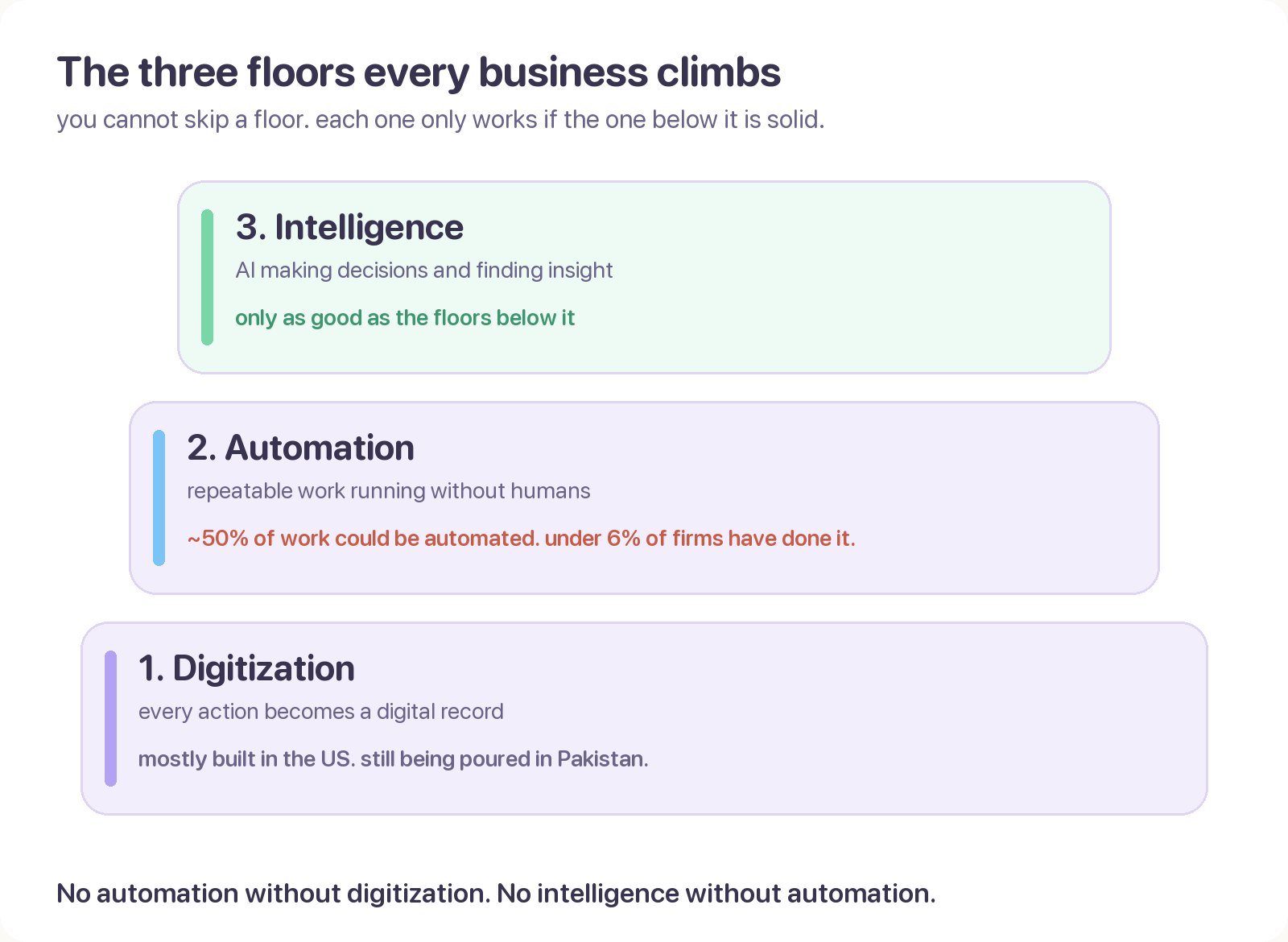
The bottom floor is digitization: turning every action a business takes into a digital record. The paper ledger becomes software, cash becomes a card terminal, the filing cabinet becomes searchable storage. Every sale and message starts leaving a signal. In the developed world this floor is mostly built. In Pakistan it is still being poured; a large share of the economy still runs on paper registers and memory, which is worth an essay of its own.
The middle floor is automation: rules that act on those signals without a human. Invoice arrives, gets logged. Stock runs low, order goes out. This was the if-this-then-that decade, and it was expensive because every rule had to be mapped and hard-coded by people.
The top floor is intelligence. AI replaces brittle hard-coded rules with judgment that adapts, and, more importantly, it reads all the signals below it and tells you things you did not know. It is also completely dependent on the two floors underneath.
How unfinished are the lower floors, really?
Far more than the AI hype assumes. McKinsey’s landmark 2017 automation study, still the reference point, found about 49% of the activities people are paid to do could be automated with technology that already existed then. The US Census then surveyed hundreds of thousands of firms and found fewer than 6% had deployed any advanced automation at all. And Harvard Business Review found, back in 2017, that only about 3% of companies’ data met basic quality standards, and nothing published since suggests the plumbing got fixed.
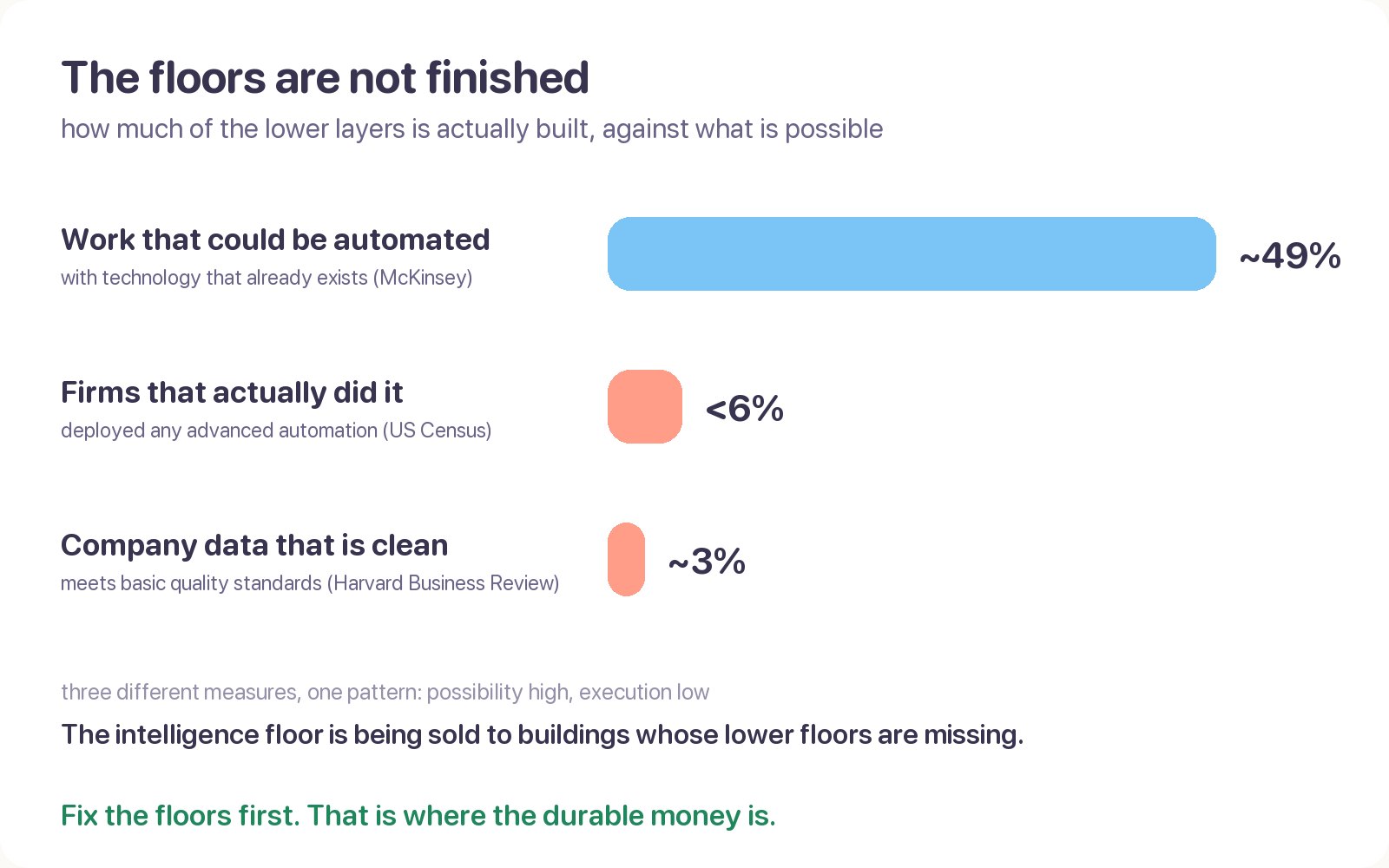
Hold those three numbers together and the state of the world becomes obvious: the intelligence floor is being sold, aggressively, to buildings whose middle floor is barely framed and whose foundation is cracked. Of course the roof falls in.
This is also why the developed world’s productivity lead persists. The economists who study automation have shown for two decades that computers absorb routine, repeatable tasks and free humans for judgment work. Countries and companies that finished their lower floors moved their people up. The ones that skipped floors got neither the automation nor the judgment.
What actually kills the AI projects?
The floors, in the studies’ own words. MIT’s diagnosis of the 95% failure rate is a “learning gap”: tools that never integrate into real workflow, which is another way of saying the automation floor was missing. Gartner’s first-named killer is poor data quality, which means the digitization floor produced garbage signals. RAND’s interviews with practitioners rank data problems second among five root causes, right after leaders pointing AI at the wrong problem, and their headline finding is that the technology itself is rarely the cause.
I have lived a small version of this. I spent this year building agentic systems, teams of AI agents doing real work, and the lesson they taught me is the thesis of this essay: the intelligence layer is only ever as good as the automation layer, which is only ever as good as the digital layer. Feed an agent clean, timely, complete signal and it performs like a brilliant employee. Feed it a mess and no model on earth saves you. Garbage in, confident garbage out.
So what should a business actually do?
Fix the floors in order, and only then buy the roof. If your records live on paper or in seven disconnected apps, the first honest AI investment is not AI at all: it is digitization, one clean system for sales, stock, money and customers. For most small businesses that means a proper point-of-sale plus cloud accounting, nothing fancier. If your processes exist only in your head, map them, then automate the repeatable ones. That work is unglamorous and it is the actual prerequisite. A useful tell: if you cannot answer “what were my five best-selling items last month” in under a minute, you are not ready for an AI strategy, and that is fine, because now you know which floor to build.
And if you are a builder deciding what to sell in this cycle, notice where everyone else is standing. The famous companies are all fighting on the intelligence floor. The floors below, digitizing and automating the millions of ordinary businesses that skipped them, have almost no competition and, as the numbers above show, nearly all of the unmet need. I made the market case for that in the enterprise-to-small-business essay, and the timing case in the three cycles. The same layering argument, applied to entire countries, runs through my sovereign AI series.
So the next time someone tells you AI failed them, ask one question: which floor did it fall through? The answer is almost never the top one. Do not buy intelligence for a business that cannot feed it. Build from the bottom. That is the whole secret, and if you disagree, argue with me.
Sources
- 95% of GenAI pilots produce no return, MIT NANDA via Fortune, 2025
- 42% of companies abandoning most AI initiatives, S&P Global, 2025
- 30% of GenAI projects abandoned after proof of concept, Gartner, 2024
- 80%+ AI project failure and root causes, RAND, 2024
- 49% of work activities automatable, McKinsey Global Institute, 2017
- Under 6% of firms use advanced automation, US Census working paper, 2023
- 3% of company data meets basic quality standards, Harvard Business Review, 2017
- Task-based automation and labor, Autor, Levy and Murnane, 2003
- Poor data quality costs $12.9M a year per organization, Gartner
Hero image: paper files in a government office, by Ganesh Dhamodkar, CC BY 2.0, brightened and cropped.

Keep reading with me.
One signal-dense read each week on the AI shift: narrative, taste, and distribution. No hype, no spam, no pitch.