Three tech cycles, and you are early to the third
My uncles lost their jobs when the hardware cycle ended. My brothers built lives on the software cycle. The third cycle just started, and you are early.
My two maternal uncles and my oldest brother-in-law came to America as hardware engineers. In 2001, when the dot-com bubble burst, they lost their jobs. I watched, as a kid, what happens to skilled, hardworking people who are standing in the wrong part of a technology cycle when it turns.
Then I watched the opposite. Three of my brothers came to America between 2005 and 2010 and walked into the software industry. They were not geniuses and they did not get lucky on a startup. They showed up to the right cycle at the right time, worked steadily, and built comfortable lives from it.
Same family. Same work ethic. Opposite outcomes, and the only variable was timing. I have spent years studying the pattern behind that difference, and the conclusion of this essay is blunt: there have been three great technology cycles in forty years, the third one began in 2021 and 2022, when the models crossed the usefulness line and ChatGPT carried them to the public, and the numbers say you are still early to it. Early is where the value is.
What were the first two cycles?
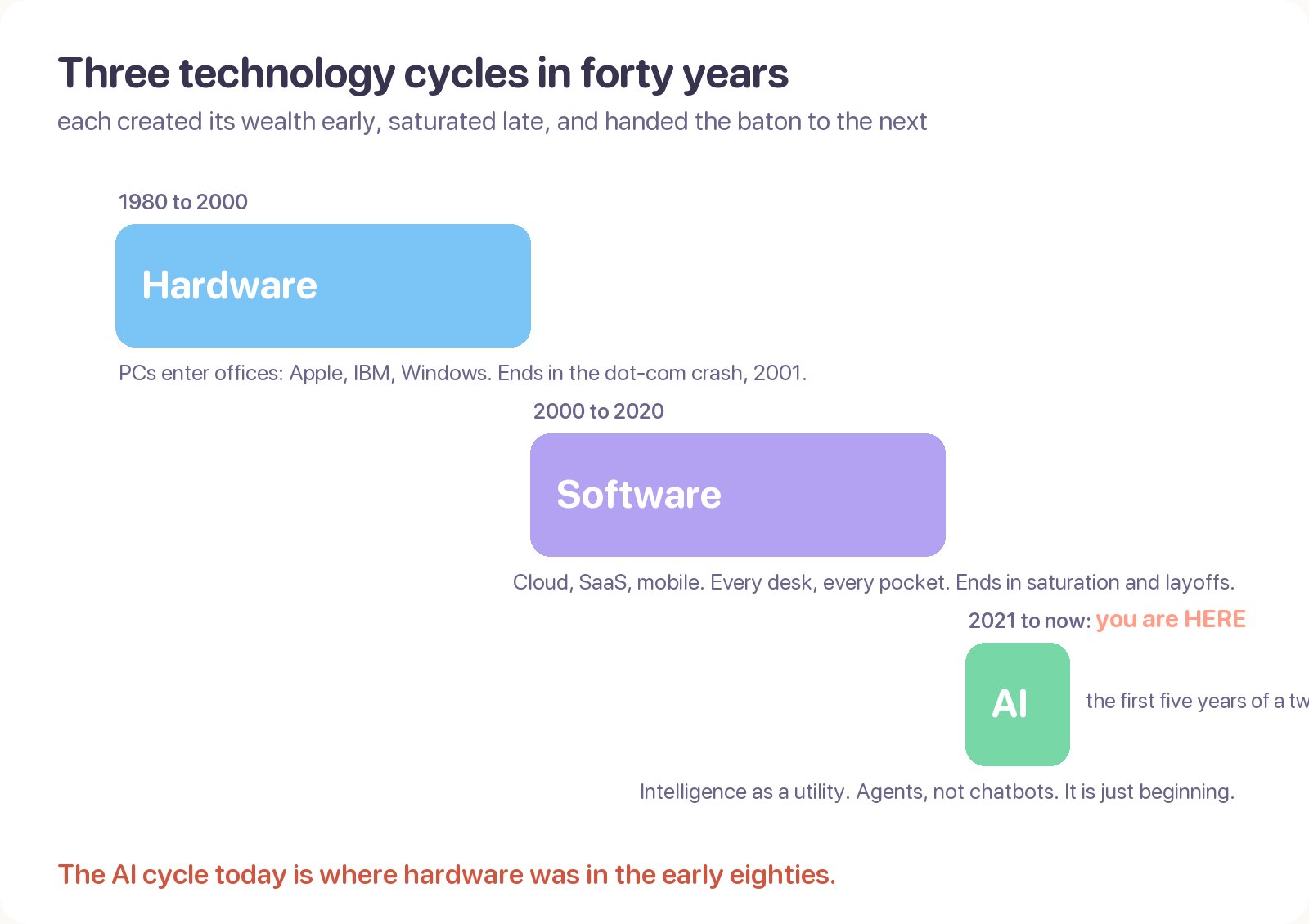
Hardware, then software. The first cycle ran roughly from 1980 to 2000, when the personal computer walked into the world’s offices: Apple, IBM, Windows. For years economists could not even find the payoff, the famous “productivity paradox”, you could see computers everywhere except in the numbers, until it landed all at once: US productivity growth jumped from about 1.5% a year to 2.5% between 1995 and 2000 (CBO, BLS). The wealth was not just for founders. Microsoft’s rise alone minted roughly twelve thousand employee millionaires, most of them ordinary staff who happened to be inside the company while the wave broke.
Then the tail came. The Nasdaq fell 78% from March 2000 to October 2002, erasing about five trillion dollars. Internet companies cut over a hundred thousand jobs in 2001 alone (Challenger, Gray and Christmas). For hardware engineers specifically, the people who built the machines, unemployment went from 1.3% in 2000 to about 7% by early 2003, a record (BLS via IEEE). That statistic is my family’s story with the names removed. My uncles were excellent at their jobs. They were simply late in a cycle that was ending, in roles that did not carry over.
The second cycle started underneath the wreckage of the first. Hardware was now everywhere, so value moved up a layer to the software running on it: the web, then cloud (AWS, 2006), then SaaS, then mobile (the App Store, 2008; US smartphone ownership went from 35% in 2011 to 81% in 2019). Businesses adopting software for the first time multiplied their output, and the people inside the industry, my brothers among them, were carried by the rising tide for two decades.
How do you know when a cycle is ending?
The supply of builders explodes while the new value shrinks. By the late 2010s every business already had every kind of software; new entrants were mostly rebuilding what existed for a marginal five to eight percent improvement. Meanwhile the world told everyone to learn to code: US computer-science degrees went from about 39,600 a year in 2010 to over 97,000 by 2020, roughly two and a half times, and kept climbing (NCES).
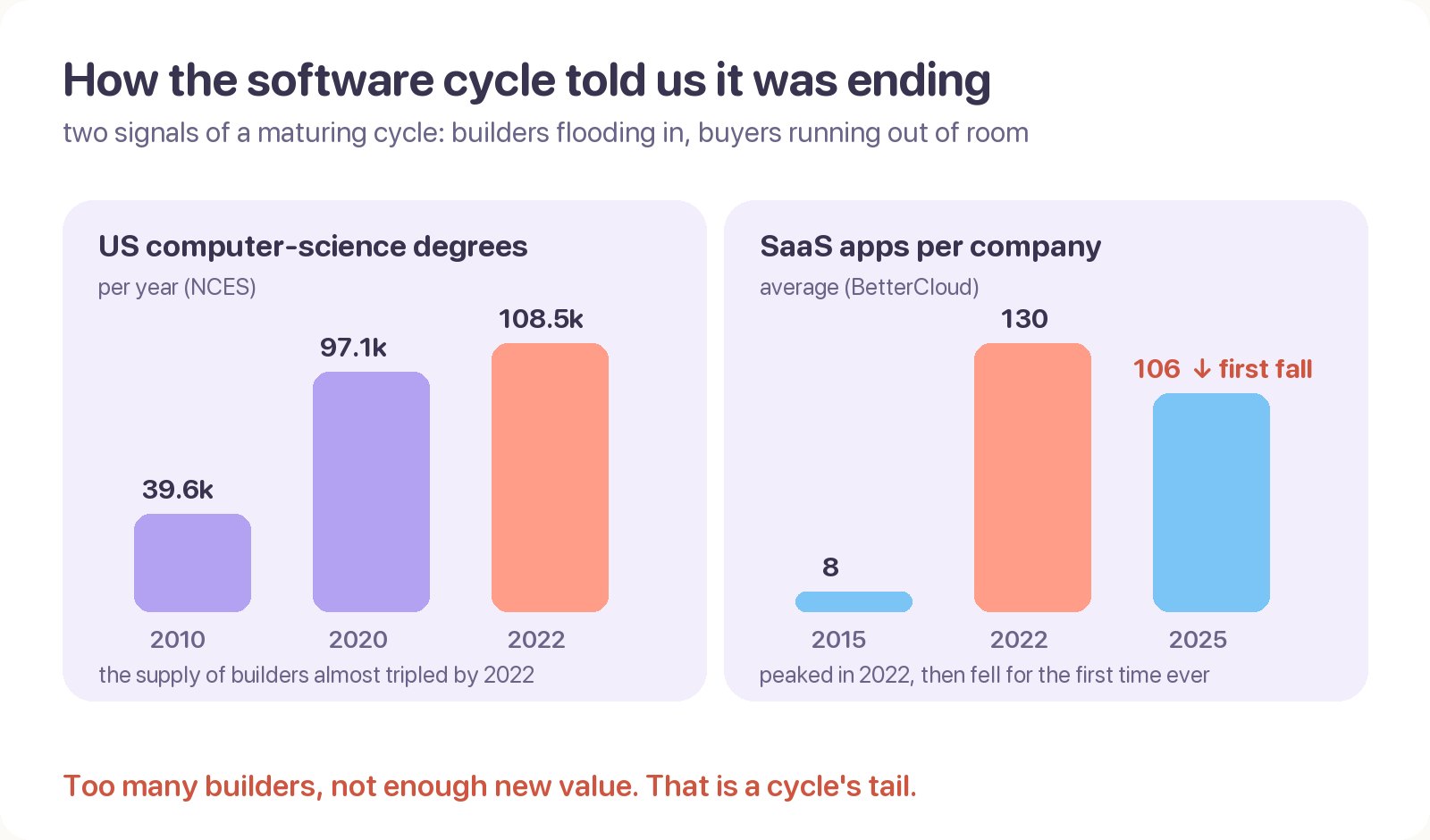
The saturation even shows up in a single strange statistic: the average company’s count of SaaS apps climbed from 8 in 2015 to a peak of 130 in 2022, then fell, for the first time in over a decade (BetterCloud). Too many builders, not enough new value to build. The layoffs of 2022 to 2024, the worst since the dot-com bust, were the tail announcing itself, at the exact moment the next cycle was starting underneath.
Why do I say you are still early to AI?
Because talking about AI and deploying AI are different things, and the gap between them is enormous. Yes, around 78 to 88% of organizations will tell a survey they “use AI” in some function (Stanford AI Index; McKinsey). But the US Census found only about 10% of firms actually run AI in the production of goods and services. Real agentic systems, AI doing multi-step work on its own, sit at roughly 5 to 11% (Deloitte; McKinsey). And MIT’s 2025 study of enterprise AI found 95% of pilots produced no measurable return at all.
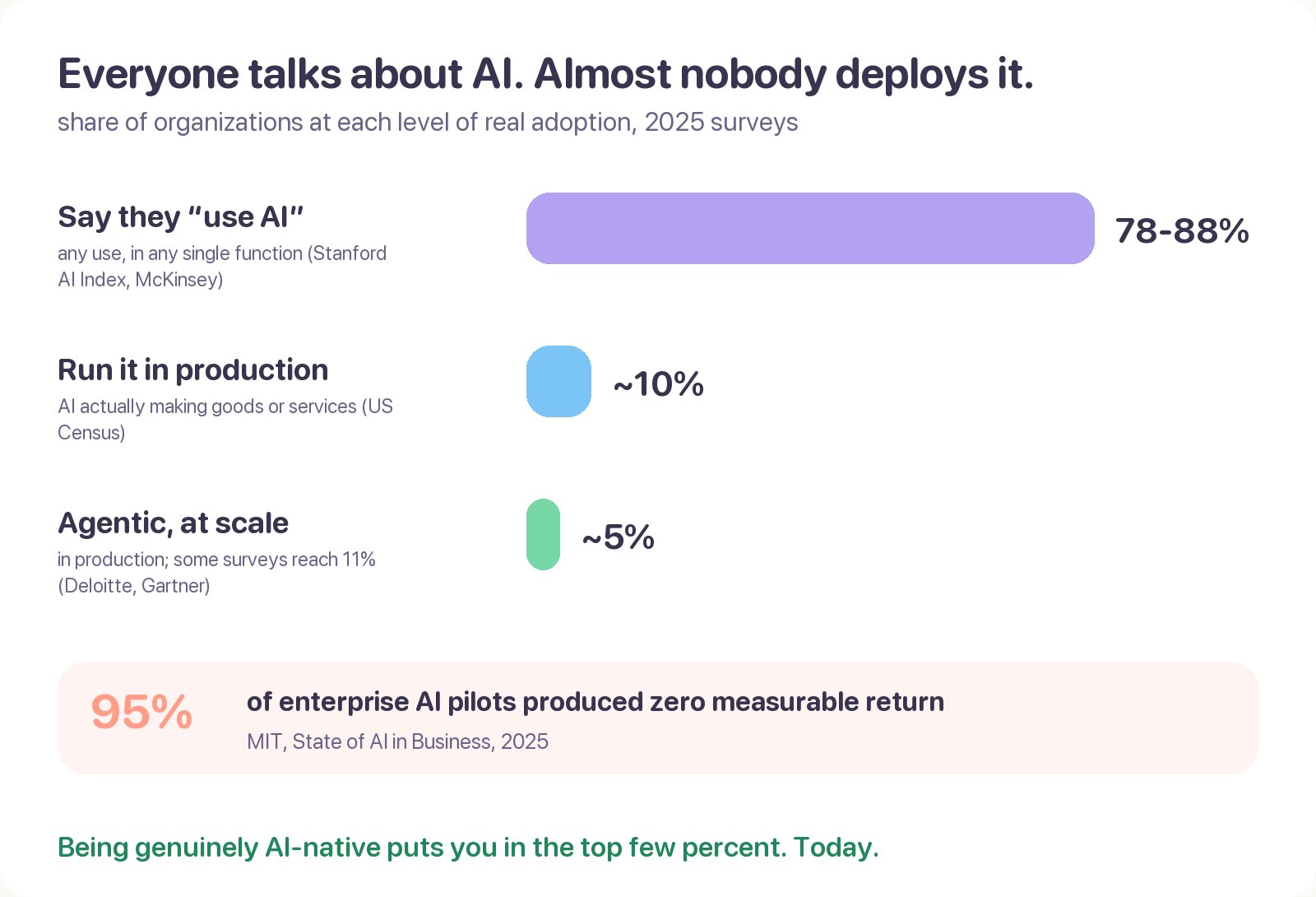
So when I say a genuinely AI-native business sits in the top few percent today, that is not motivation-speak, it is what the surveys measure. And the people who can build one are scarcer still. The AI cycle in 2026 is where the hardware cycle was in the early eighties: the technology is real, the deployment has barely begun, and almost every business that will eventually run on it has not started.
One honest caution belongs here, because I respect the pattern too much to skip it. Early is where the biggest upside lives, and also the biggest variance. The dot-com era produced Amazon and it produced Pets.com, and both were early. Economist Carlota Perez, who mapped these cycles across two centuries, found that the frenzy phase crashes before the golden age arrives. Early entry is not a guarantee. It is a door, standing open, with the best odds you will ever get.
What should you actually do with this?
Learn the layer that is scarce, not the layer that is obvious. Saying “I know how to use ChatGPT” is not an AI skill; it is the 2026 equivalent of walking into the year 2000 saying “I know some Visual Basic.” The chatbot is the surface. The real skill is building with the new tools, agents, architectures, and deployments, as they appear. Concretely: this month, take one real workflow you already do, and rebuild it end to end with agents. That single exercise will teach you more than any course, and the complexity of the stack is still low enough that you can. It compounds every year, which means every year the door narrows.
And set your expectations like an adult. My brothers did not get rich in year one of the software cycle. They kept showing up for years, and the cycle carried them. This one is the same: you will probably not make serious money in twelve months. But a cycle that has just begun, entered early and worked patiently, can fund a career for twenty years. That is what the last two cycles did for the people who caught them on time.
I have written about what to build in this cycle in the enterprise-to-small-business essay, and about why most AI attempts fail in Your AI isn’t broken. The macro version, why whole countries face this same timing decision, is my sovereign AI series. And the underlying worldview is the thesis.
My uncles were too late to their cycle. My brothers were on time for theirs. You are early to the biggest one yet. That is not luck. That is a door, and doors close. Tell me which side of it you are standing on.
Sources
- US labor productivity acceleration 1995-2000, Congressional Budget Office
- Microsoft employee millionaires, The Washington Post, 2003
- Dot-com job cuts, Challenger Gray via Computerworld
- Electrical engineer unemployment 2000-2003, IEEE-USA citing BLS
- US smartphone adoption, Pew Research
- Computer science degree counts, NCES
- SaaS apps per company peak and decline, BetterCloud
- Organizational AI use, Stanford HAI AI Index 2025
- AI in production, US Census Business Trends survey via EIG
- Agentic AI adoption, Deloitte 2025
- 95% of GenAI pilots deliver zero return, MIT NANDA 2025
- Technological Revolutions and Financial Capital, Carlota Perez, 2002
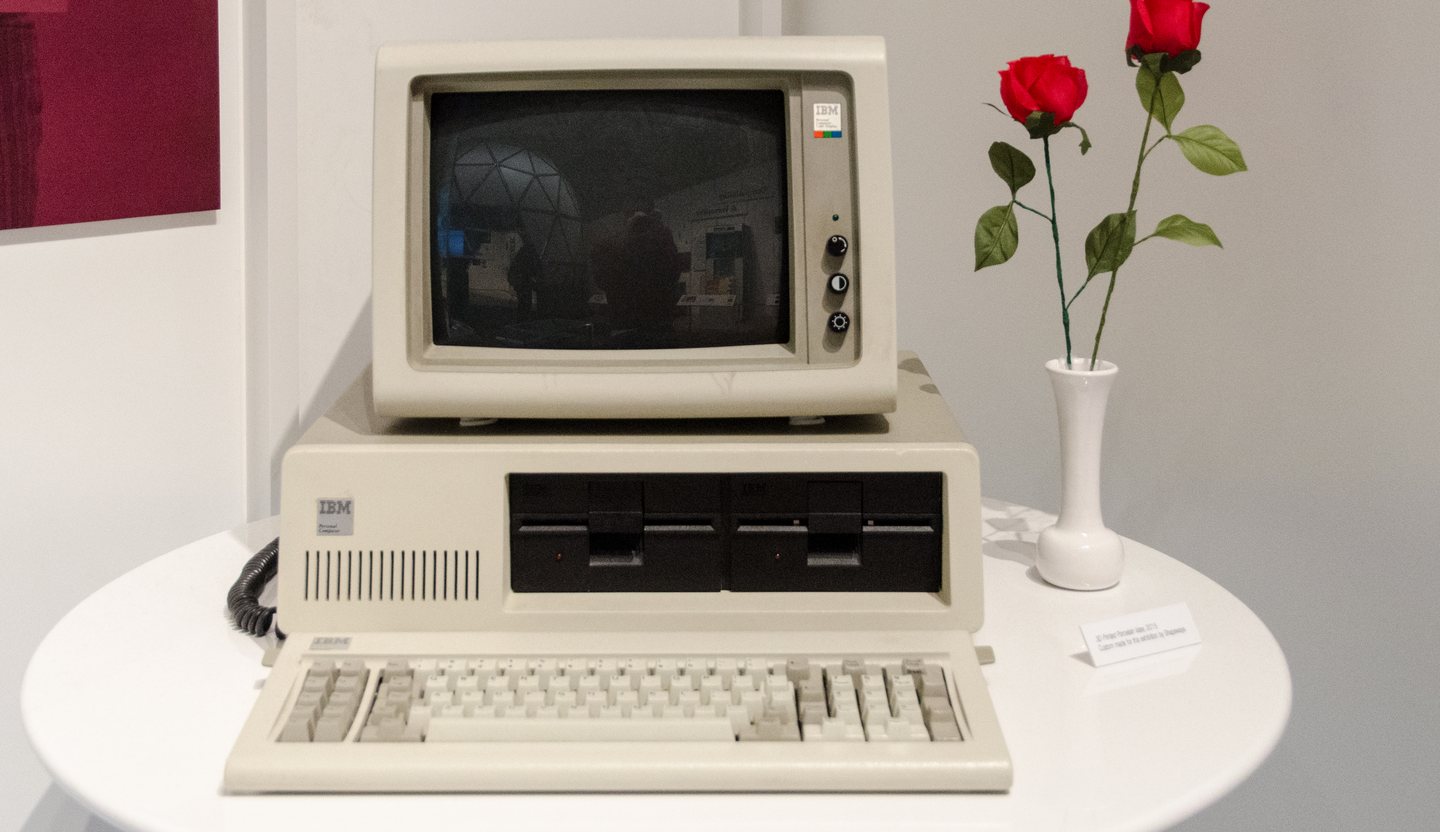
Hero image: IBM PC 5150, by edwardhblake, CC BY 2.0, cropped.
.jpg)
Keep reading with me.
One signal-dense read each week on the AI shift: narrative, taste, and distribution. No hype, no spam, no pitch.