Owning the stack: the case for sovereign AI
A country that cannot pay its electricity bills should build its own AI infrastructure. Here is why that is not as mad as it sounds.
I have been making an argument that sounds absurd on its face: a country that struggles to pay its electricity bills should build its own artificial intelligence infrastructure.
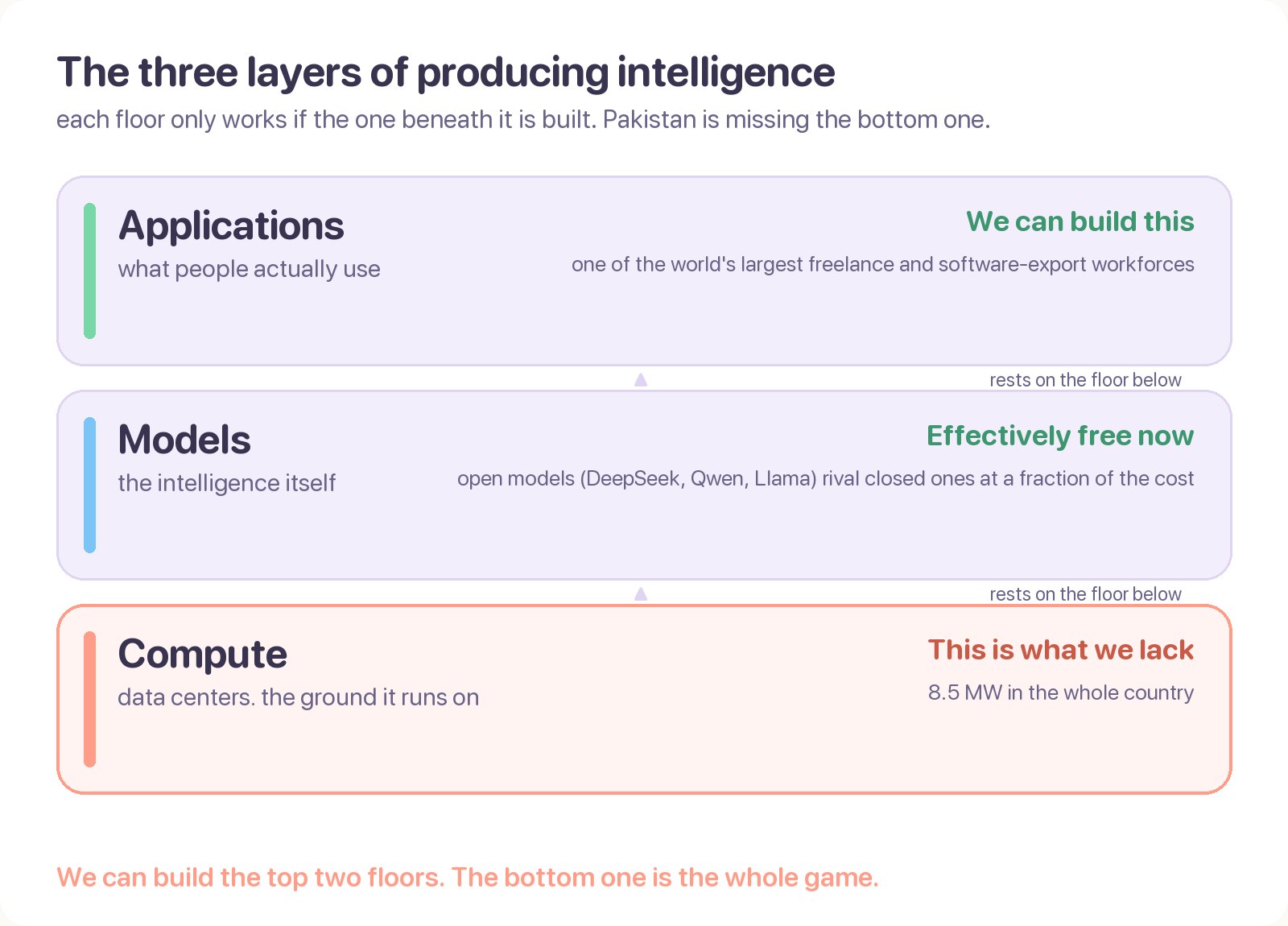
Here is why it holds. There are three layers to producing intelligence, and Pakistan already has access to two of them. Applications our software houses can build today. Open models like DeepSeek and Qwen now rival the closed ones at a fraction of the cost, so the intelligence itself is close to free. The only missing floor is compute, and the strange thing about Pakistan is that we built a power system for a country twice our size and use about a third of it.
The missing floor is the one we are unusually well placed to pour. This essay works through what sovereign AI actually means, why the grid is an asset rather than an obstacle, and who should build it.
What does sovereign AI actually mean?
It means a nation producing its own intelligence, using its own infrastructure, data, models, and people. Nvidia’s Jensen Huang put the phrase on the map in Dubai in February 2024, telling assembled governments that “every country needs to own the production of their own intelligence” and warning that a nation’s data “codifies your culture, your society’s intelligence, your history. You cannot allow that to be done by other people.”
Understand the difference between this and what governments usually produce. An AI strategy is a PDF. A committee. Sovereign AI is the opposite of a PDF: it is owning the means of production. Own the layers and you produce intelligence. Rent them and you consume it, in dollars, forever, which is the trap I described in the dollar essay.
Who is already building this?
Almost every country that matters, and the pace should embarrass us. India launched the IndiaAI Mission with roughly 1.25 billion dollars committed and a GPU pool that has grown past 34,000, and picked a startup, Sarvam, to build a sovereign foundation model in Indian languages.
The UAE built Falcon out of Abu Dhabi and is constructing a five-gigawatt AI campus with a one-gigawatt cluster inside it. Saudi Arabia created HUMAIN, owned by its sovereign wealth fund and chaired by the crown prince, targeting 1.9 gigawatts by 2030 with a first order of 18,000 of Nvidia’s most advanced chips. The European Union committed 20 billion euros for five “AI gigafactories,” and its stated reason is worth quoting: to “reduce the dependence of European players on non-European suppliers.” Even the richest club of nations on earth is afraid of renting.
But the country I want Pakistanis to look at is Indonesia. Not a Gulf petrostate. They built Sahabat-AI, their own open model in Bahasa Indonesia and regional languages including Javanese and Sundanese, running on domestic infrastructure. It was built by a telecom company and a technology company, Indosat and GoTo, partnered with Nvidia.
No 77 billion dollars. A telco, a tech firm, and a decision. That is the model that fits us.
Which layers can Pakistan actually reach?
Two of the three, today, without heroics. The application layer is work our industry already does, with one of the largest freelance and software-export workforces on the planet. The model layer went from locked to open over the last two years.
That second shift deserves more attention than it gets in Pakistan. The best American labs keep their models closed and rent them to you through an API. China went the other way. DeepSeek, Qwen and others released their weights openly, and the gap between open and closed models has collapsed from tens of points to low single digits on most benchmarks, at six to fifty times less cost to run.
So the bottleneck is no longer the model. It is the machine room.
Why is our broken grid actually an advantage?
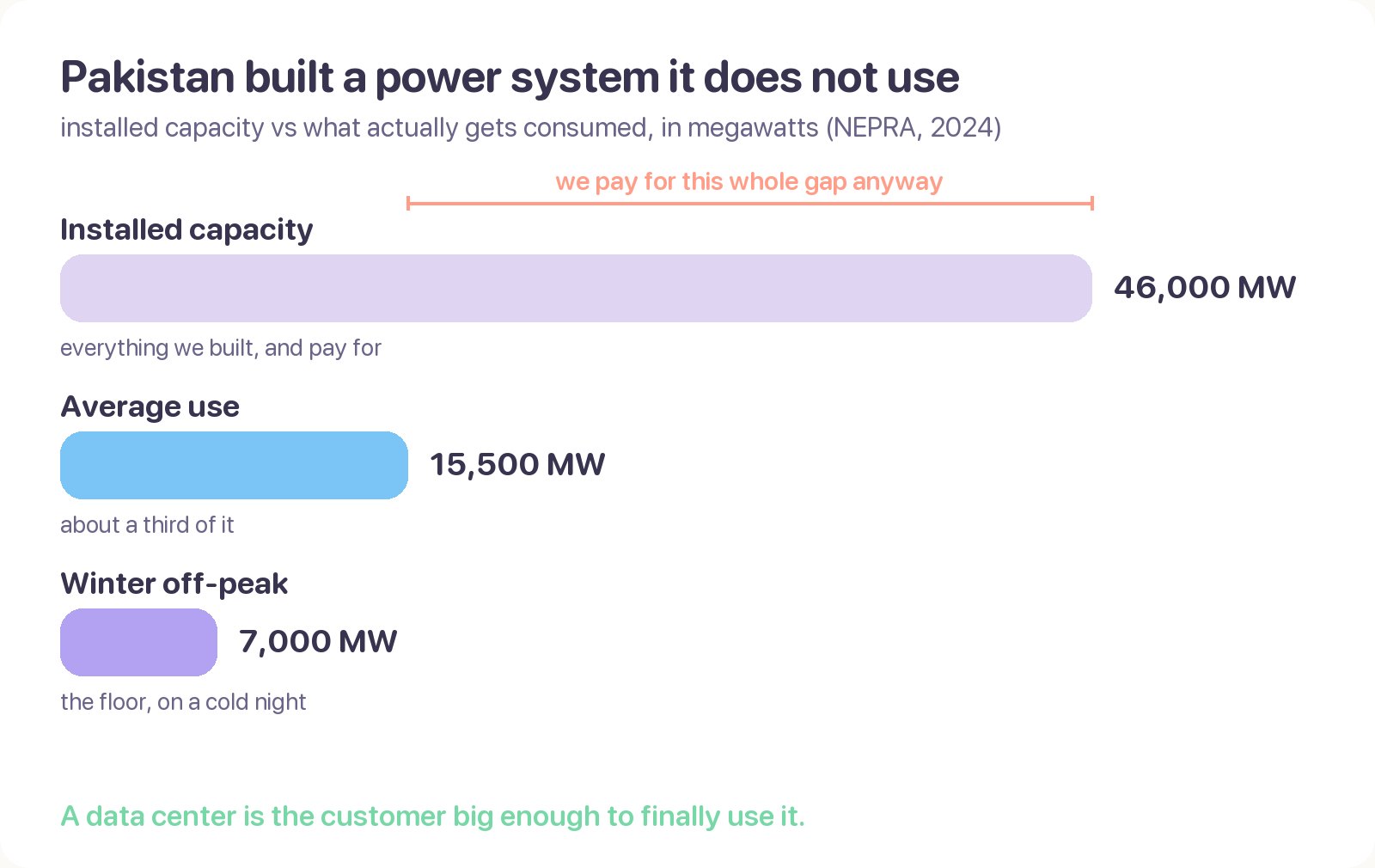
Because it is not short of capacity. It is short of customers. Pakistan has around 46,000 MW of installed generation. Average use runs about a third of that, and on a winter night demand can fall to roughly 7,000 MW (NEPRA, State of Industry Report 2024).
And here is the poison in the system: we pay for the idle plants regardless. Roughly two trillion rupees a year in capacity payments, about 71% of the power purchase price, for capacity that mostly sits there.
Now think like an economist for one second. What does a system like that need? Not another household that draws power for four hours in the evening. It needs a customer that runs twenty-four hours a day, seven days a week, and pays on time. Every unit that customer buys spreads the fixed capacity cost over more units, which pulls the per-unit burden down for everyone else.
A data center is precisely that customer. It runs at eighty to ninety percent load, day and night, all year. In a grid like ours it does not strain the system. It rescues it. We built the power station and forgot to build the factory.
The government already knows. Pakistan earmarked 2,000 MW for AI and crypto data centers in May 2025, drawing on a stated surplus. Where I differ is on how. That plan offered subsidized power, and the IMF pushed back in July 2025, citing market distortion. The IMF was right about the subsidy. Sell the power at a fair market price, and the buyer still wins, the grid still heals, and nobody gets a sweetheart contract to defend twenty years from now. We have seen what those contracts do.
Two more things are moving in our favour. Rooftop solar went from about 1.3 GW to over 6.1 GW in two years, one of the fastest adoption curves anywhere. And the expensive old IPP contracts begin expiring from 2027, starting with Hubco’s 1,292 MW.
Aren’t the chips impossibly expensive?
Today, yes. But that is a snapshot of a buying frenzy, not a permanent condition. The cost of running a given level of intelligence has been falling five to ten times every year, and GPUs typically lose around 30% of their price within a year or two of launch (Epoch AI).
China is also breaking the monopoly. Huawei is now producing its own AI accelerators at scale on domestic process technology. The moment there are two serious sellers instead of one, prices change for everybody. We do not need to buy at the top of the market. We need to be ready, with buildings, power and fiber, for when the price breaks.
Let me be straight about the part that does not resolve neatly. The chips are imported, they cost dollars, and they wear out. More than half the capital cost of an AI data center is the compute inside it. So building locally does not make Pakistan magically independent of the dollar.
But compare the two positions honestly. Renting tokens is a bill that never stops, priced by someone else, forever. Buying hardware is an asset: you pay once, run it for years, and everything it produces afterwards, the electricity, the bandwidth, the salaries, the applications, is denominated in rupees and stays home. One is rent. The other is ownership with a maintenance cost. Countries are built on the second.
Who should build it?
Not the government. Every time the Pakistani state has entered the energy business, it has ended the same way: guaranteed returns, denominated in dollars, backed by sovereign guarantees, for a handful of connected players, and the whole country still paying thirty years later. Invite the government to lead this and we will get AI-branded rent-seeking.
This has to be industry. And I am looking at a specific group: the software houses and IT exporters who have made real money over twenty years selling services to the world. I sit in those conversations. You are watching AI eat the exact services you sell, and you are nervous.
So invert the fear. If AI is going to consume your service business, own the thing AI runs on. You have the capital, the technical depth, and the customer, because you and everyone like you will be buying tokens either way. The only question is whether those tokens are bought from Virginia in dollars, or produced in Karachi and Lahore and sold in rupees, by you.
The nuclear program needed a state, because only a state can build a weapon. This does not. It needs a consortium of businesses that can see five years ahead.
What remains is the arithmetic: how much capacity a country of 250 million people actually needs, and what it would cost. That is the next essay. Read my thesis for the wider argument, or get in touch if you are building in this space.
Sources
- Nvidia on sovereign AI and Jensen Huang at the World Governments Summit, Dubai, 2024
- IndiaAI Mission budget and GPU procurement
- Stargate UAE and the five-gigawatt campus, OpenAI
- Saudi Arabia’s HUMAIN, Public Investment Fund
- EU AI gigafactories and the sovereignty rationale, European Commission
- Indonesia’s Sahabat-AI, Indosat and GoTo
- Open-weight vs closed model performance, Epoch AI
- Installed capacity, demand and utilisation, NEPRA State of Industry Report 2024, via Business Recorder
- Capacity payments, Renewables First Pakistan Electricity Review 2025
- 2,000 MW allocated to AI and crypto data centers, The Express Tribune
- IMF pushback on subsidised power for data centers, CoinDesk
- Net-metered solar growth, pv magazine
- IPP contracts expiring from 2027, Business Recorder
- AI compute price-performance trends, Epoch AI
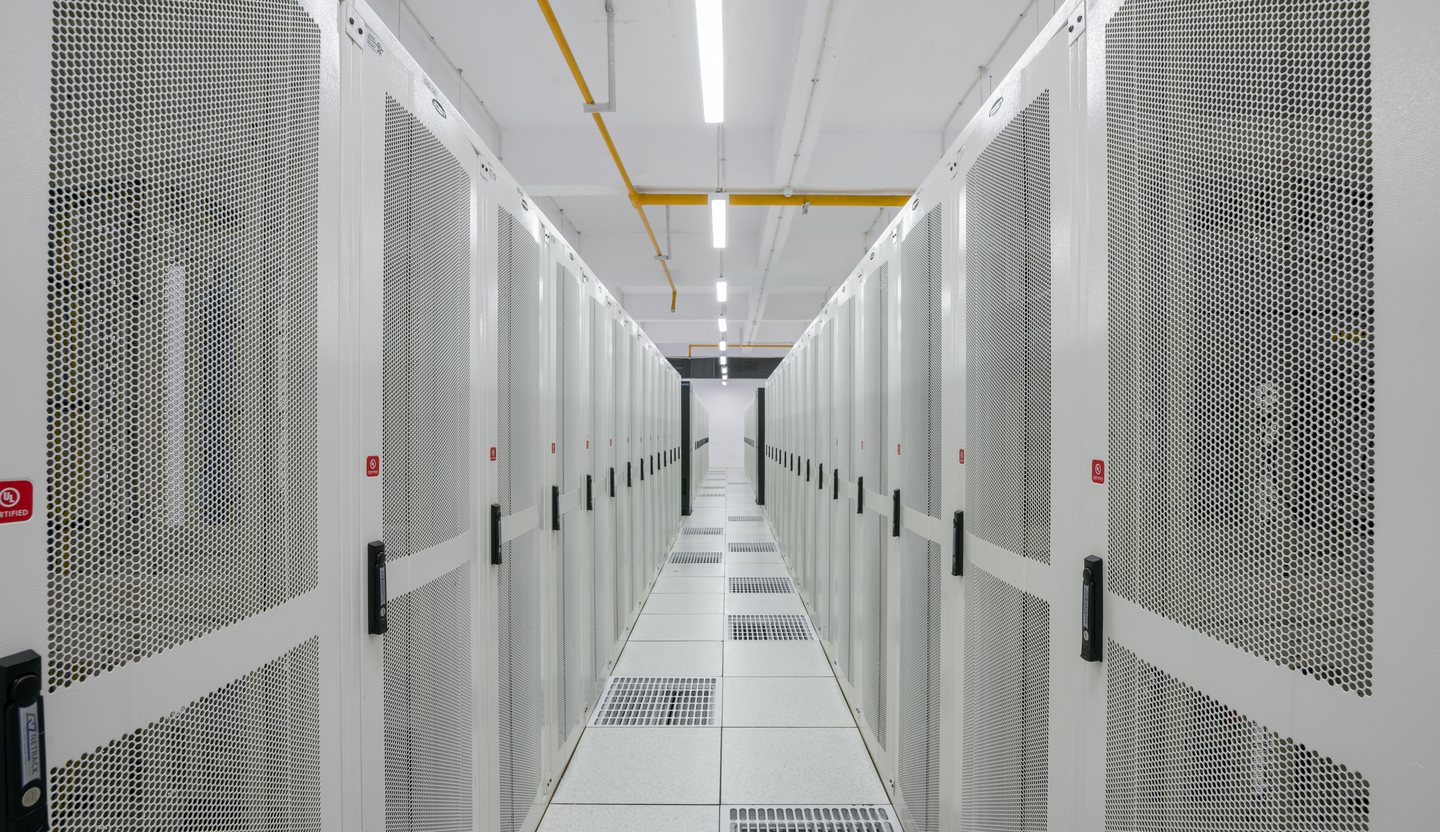
Hero image: data-center racks, by PiDatacenters, CC BY-SA 4.0.

Keep reading with me.
One signal-dense read each week on the AI shift: narrative, taste, and distribution. No hype, no spam, no pitch.