The dollar trap: why we can't afford nice things
Pakistan rents almost everything it lacks, and it rents it in dollars. That single fact is the ceiling on how far this country is allowed to grow.

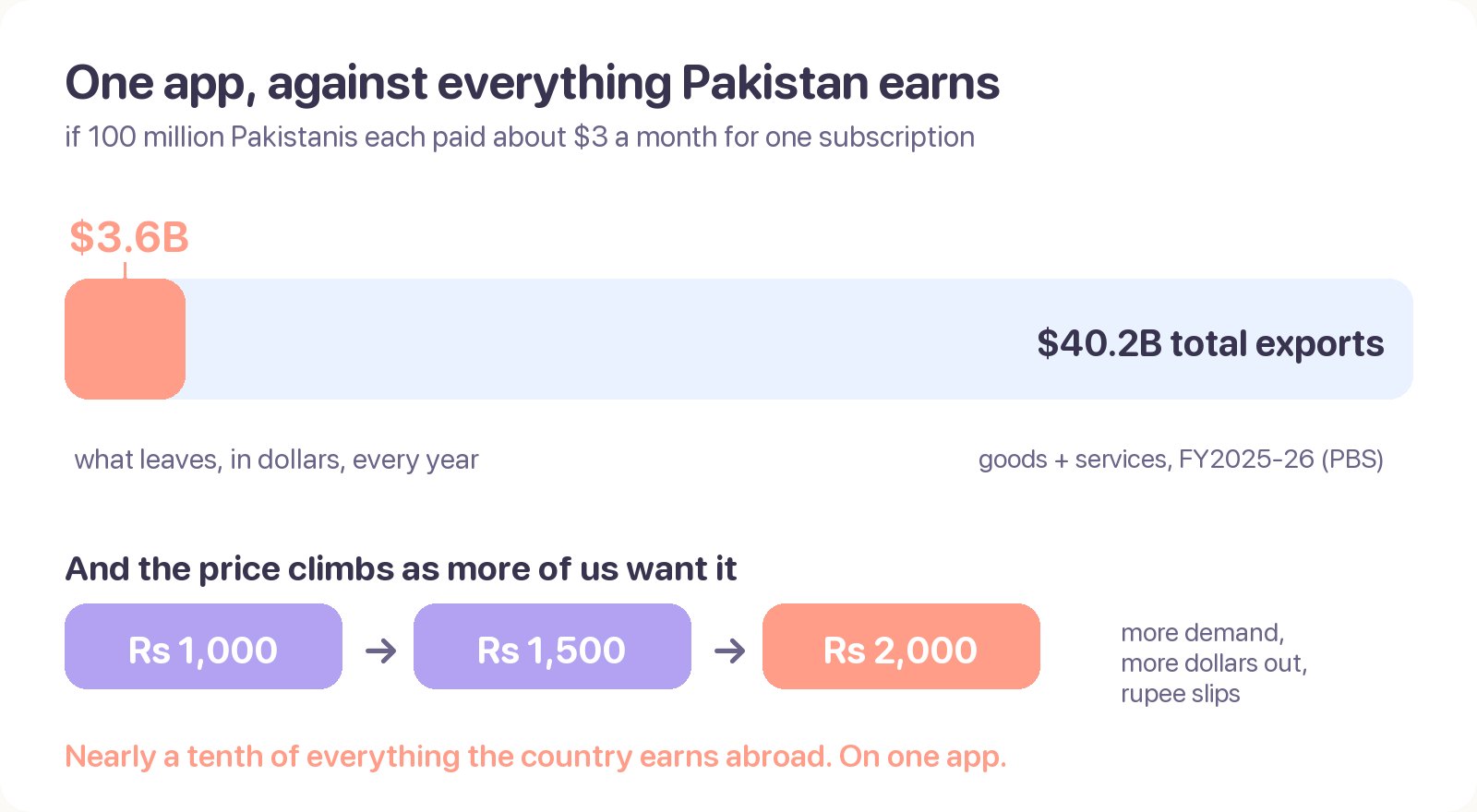
Imagine every Pakistani with a smartphone paid for one streaming subscription. A thousand rupees a month. Harmless, surely.
Run the number. A hundred million accounts at around three dollars a month is 3.6 billion dollars a year. Pakistan’s total exports of goods and services were about 40.2 billion dollars in FY2025-26 (Pakistan Bureau of Statistics). So one app would eat close to a tenth of everything this country earns from the entire world.
It will never happen, and the reason it will never happen is the whole point of this essay. Long before we got there, the pressure on the dollar would push the rupee down, the thousand-rupee plan would become fifteen hundred, then two thousand, and people would quietly cancel. The price climbs until enough of us are pushed out.
That is not a story about streaming. It is the mechanism that sits on top of every good thing in this country. And it is about to be applied to the most important input of the next twenty years.
What are the four things an economy actually runs on?
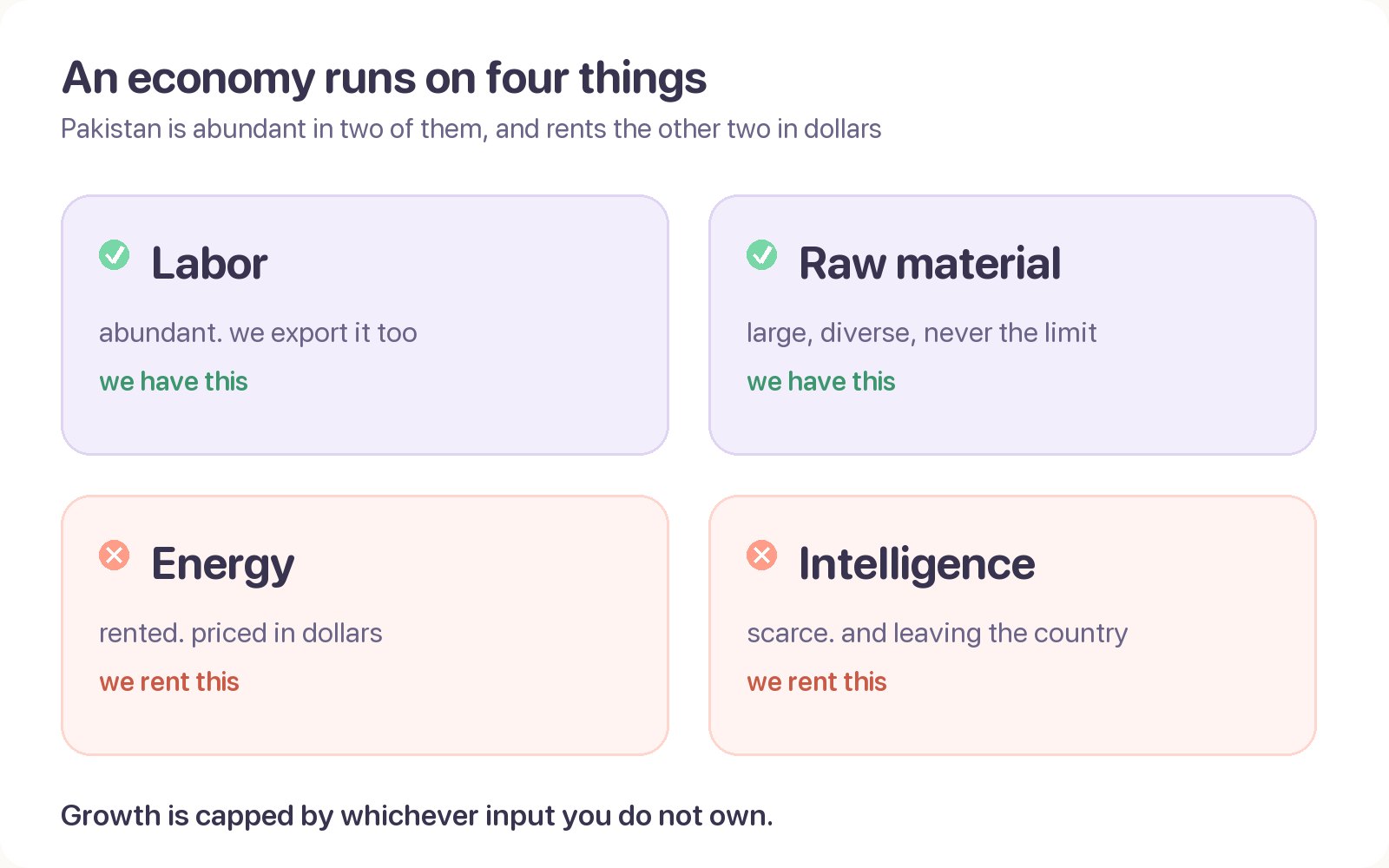
An economy is an amalgamation of four variables: intelligence, labor, energy, and raw material. Growth is bottlenecked by whichever one you lack. That is the whole framework, and once you see it you cannot unsee it.
Ask where Pakistan stands on each. Labor, we are swimming in it, so much that we export it. Raw material, we are a large and diverse country, and it has never truly been the binding constraint. Those two we have.
Energy and intelligence are the two we do not have. And our answer, for the entire history of this country, has been to rent them. In dollars.
Why is Pakistan’s energy priced in a currency we don’t earn?
Because we import most of it, and because the contracts were written that way. Petroleum alone accounted for 22.2% of the national import bill, according to Finance Minister Muhammad Aurangzeb in 2026, and Pakistan imports over 80% of its crude.
The oil bill hit 16.86 billion dollars in FY2025-26. Every ten-dollar rise in global crude adds roughly 1.8 to 2 billion dollars to that bill. We did nothing, used nothing extra, and the money left anyway because a price moved somewhere else in the world.
Gas is the same shape. Pakistan buys LNG from Qatar on ten and fifteen year contracts, priced in dollars, indexed to a percentage of Brent crude, on take-or-pay terms. We pay whether we use it or not. There is a bitter irony in the current moment: LNG demand fell to a five-year low as solar spread, so we are now trying to defer cargoes we are contractually obliged to buy.
How did we do the gas crisis to ourselves?
We underpriced our own gas, burned it in cars, and then had to import it. At the peak, around 80% of Pakistan’s cars ran on CNG, second only to Iran, because we deliberately kept it cheaper than petrol.
It felt like a blessing. It was a bonfire. We burned through domestic reserves on the roads, the wells ran short, and by FY2015 we were importing LNG to replace the gas we had wasted. The economist Farrukh Saleem called it what it was, a massive policy failure, noting the government promoted CNG knowing full well the reserves would not last.
Underprice a scarce thing and you will waste it. Then you will import it. Hold on to that sentence, because it comes back when I write about water.
Why is electricity dollar-pegged when we generate it here?
Because our own governments signed it that way. In the 1990s Pakistan invited private investors to build power plants and gave them guaranteed returns, backed by the state, with the return on equity indexed to the US dollar.
So today we pay roughly two trillion rupees a year in capacity payments, money for plants to merely exist, whether they generate or not. That is about 71% of the power purchase price (NEPRA, Renewables First). Seventy-one percent of your bill is not electricity. It is the contracts.
And because those returns are dollar-indexed, every slip in the rupee raises your bill. The textile industry association APTMA estimates that had the rupee held at 100 to the dollar, that capacity bill would be around 750 billion rupees instead of over two trillion. A third of what it is. The rest is the exchange rate.
How many dollars does Pakistan actually earn?
Less than you would think, and the composition should worry you. Goods exports were 30.1 billion dollars in FY2025-26. Add services and it reaches 40.2 billion.
Then look at remittances: 41.58 billion dollars, an all-time record (State Bank of Pakistan). More than every physical good this country sold to the entire world.
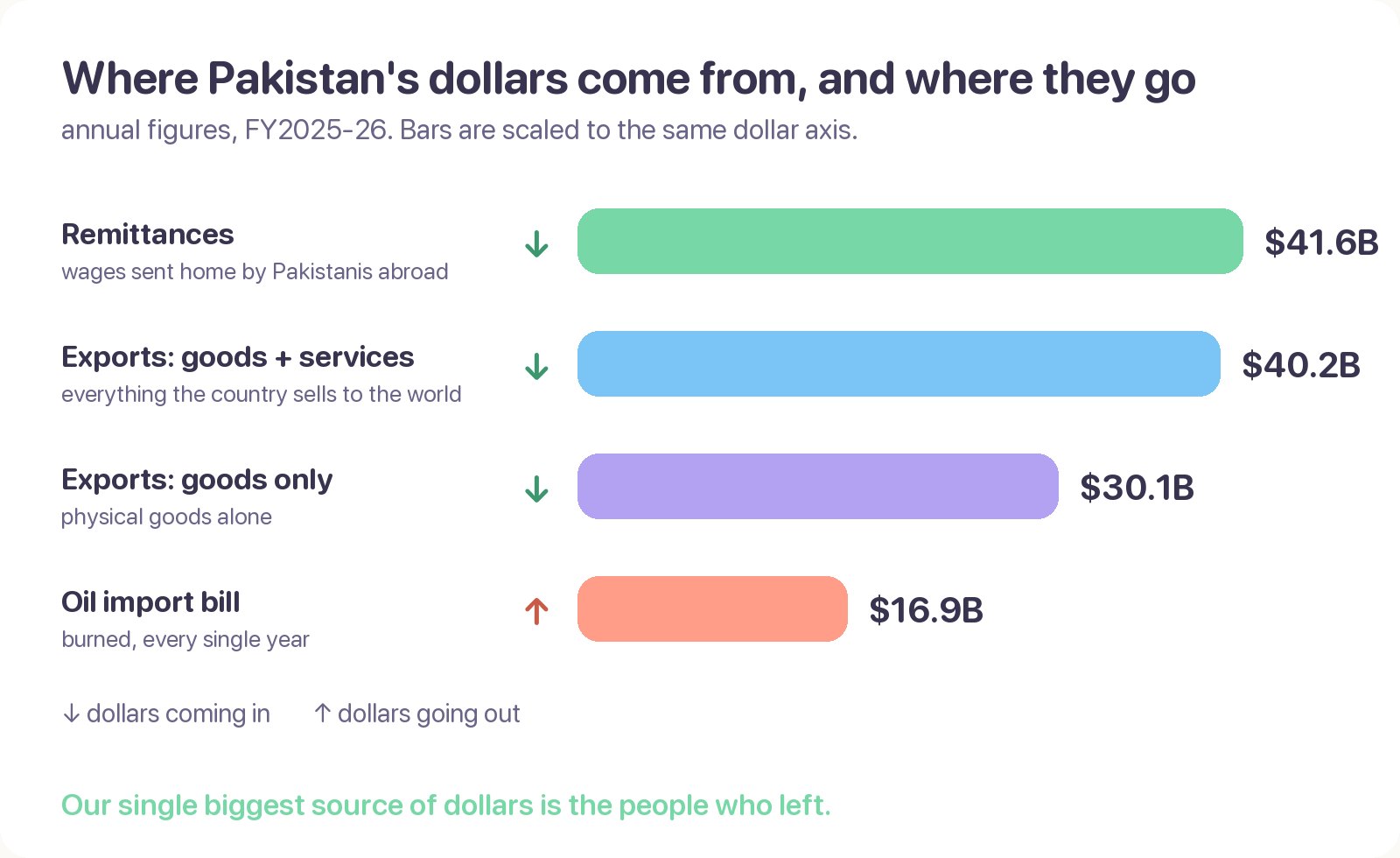
Sit with what that means. Our single largest source of dollars is not what we make. It is the wages of the people we sent away.
And we keep sending them. Over 727,000 Pakistanis left for work in 2024, and more than 862,000 the year before, according to the Bureau of Emigration. In roughly two years we lost around 5,000 doctors and 11,000 engineers. Highly skilled emigration rose 119% in a single year, by the government’s own Economic Survey.
Turn that around and see it properly. The developed world has been importing intelligence for fifty years. Every doctor who lands in London is a fully formed mind that another country paid to raise, arriving free. Immigration was never charity. It was the wealthy world importing the scarcest input in economics.
So this is Pakistan’s position: rich in labor and raw material, renting energy in dollars, and exporting the intelligence we do produce. We ship both of our scarce inputs abroad and then wonder why growth stalls.
What happens when intelligence becomes something you buy?
It becomes the fourth input we rent in dollars, and the ceiling drops onto everything at once. Artificial intelligence is intelligence sold by the token, the way electricity is sold by the unit. For the first time, the scarcest input in economics has a price list.
It will teach our children, treat our patients, run our businesses, and argue our cases. Whoever has abundant, cheap intelligence will grow the way countries with abundant, cheap energy grew in the last century.
And how is Pakistan set up to receive it? The same way as always. Cloud tokens. API tokens. Subscriptions. All priced in dollars, all leaving.
If a rupee-earning country rents its intelligence in dollars, then the amount of intelligence it is allowed to use is capped by its exports. Our children’s education, capped by exports. Our patients’ care, capped by exports. That is what renting does, and it is why I keep saying this is not a technology story. It is a sovereignty story.
If that same intelligence were produced here, running on our own electricity and infrastructure and priced in rupees, it would not matter whether one million people used it or a hundred million. The money would circulate at home. More usage would mean more growth, not more pressure on the dollar.
That is the argument for building it here, and I made the first part of it when I showed that data centers will not drink Pakistan dry. The next piece works through what owning the stack would actually involve, and why our broken, overbuilt power grid turns out to be the best asset we have.
I write about this because I think it is the most important economic decision of the next decade, and almost nobody is framing it correctly. Read my thesis for where this fits in the bigger argument, browse the rest of my writing, or get in touch if you are working on this.
Sources
- Pakistan Bureau of Statistics trade data, FY2025-26, via The Express Tribune
- Services exports FY2025-26, The Nation
- Record remittances of $41.6 billion, State Bank of Pakistan
- Petroleum at 22.2% of the import bill, Finance Minister Aurangzeb, via Profit
- Annual oil import bill, FY2025-26, The Nation
- Qatar LNG contract structure, The Express Tribune
- Pakistan’s LNG surplus and take-or-pay problem, IEEFA
- Farrukh Saleem on the CNG policy failure, Gulf News
- Capacity payments and the power purchase price, The Friday Times
- Dollar-indexed IPP returns and the capacity-payment burden, IEEFA
- Record worker emigration in 2024, Bureau of Emigration, via Profit
- Netflix Pakistan pricing, Statista
Hero image: oil tanker at Karachi Port, by A.Savin, Wikipedia, Free Art License 1.3.

Keep reading with me.
One signal-dense read each week on the AI shift: narrative, taste, and distribution. No hype, no spam, no pitch.