No, AI data centers won't drink Pakistan dry
Pakistan's first AI data center triggered an imported water panic. The real math: a full gigawatt would use about 0.01% of our water.
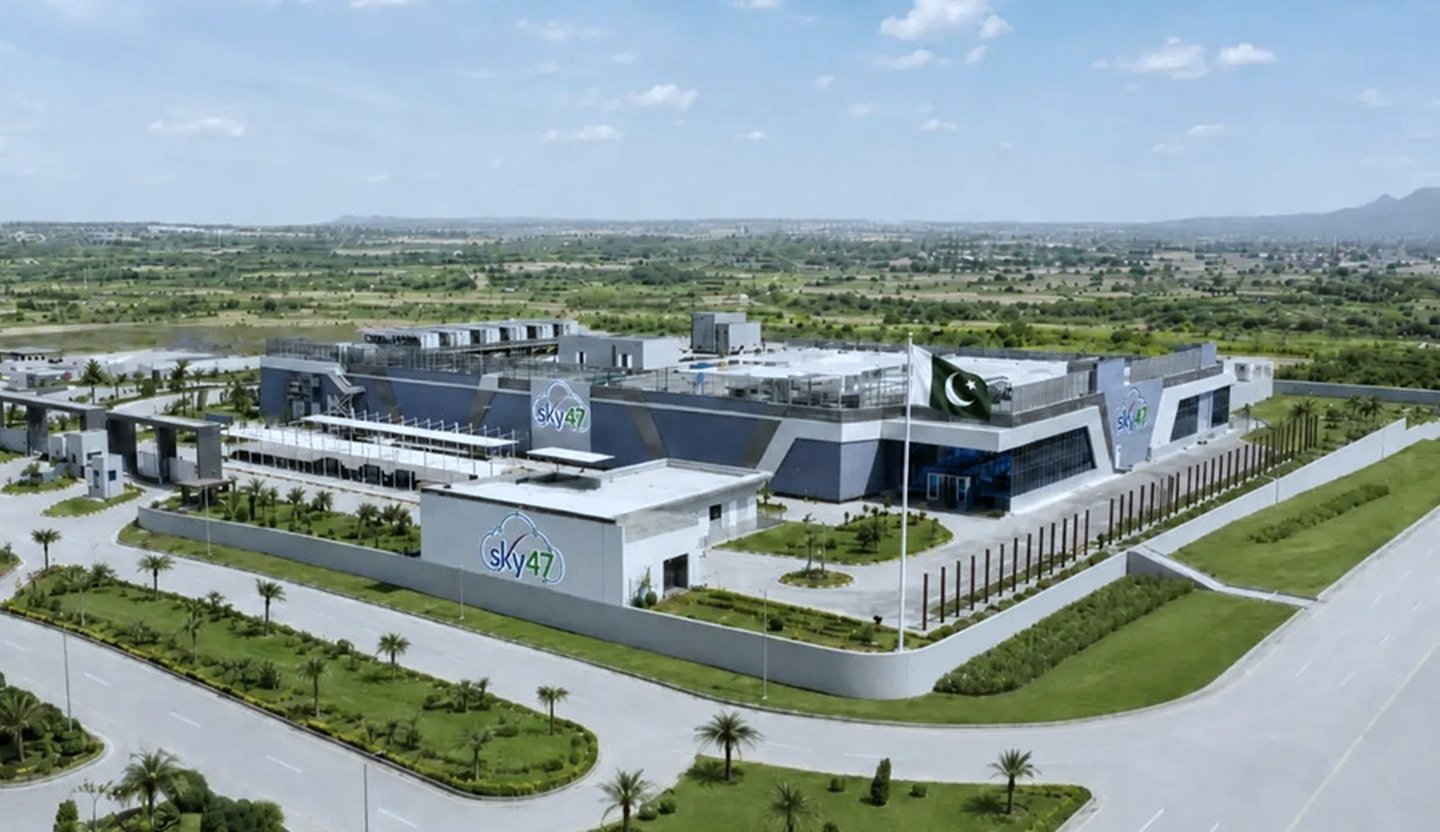
Two weeks after Pakistan switched on its first real data center, Sky47’s Karakoram-01 in Islamabad, a panic swept through my feed: these machines will drink our water and burn our electricity.
I ran the numbers. A full gigawatt of AI data centers, more than a hundred times everything Pakistan has today, would consume about 0.01 percent of the country’s annual water. One part in ten thousand. Even with the thirstiest cooling technology on earth, the figure is 0.04 percent. To use even one percent of Pakistan’s water, we would need to build fifty to a hundred gigawatts. We have 8.5 megawatts.
The panic is not slightly exaggerated. It is wrong by a factor of a hundred. And it was not born here. It was imported, almost word for word, from American headlines about American towns. This essay traces where the fear came from, walks through the actual math, and asks the question the panic is drowning out: who is going to own the intelligence these buildings produce?
Where did the water panic come from?
Every viral claim about data centers and water traces back to a handful of American news stories from 2023 to 2025. None of them are about Pakistan, and the most famous one partially collapsed under scrutiny.
The first was an Associated Press investigation (September 2023) into Microsoft’s campus in West Des Moines, Iowa, which pulled 11.5 million gallons of water in a single month, about 6 percent of the district’s supply, while training GPT-4. The second was a University of California, Riverside study, “Making AI Less Thirsty” (2023), the source of the two lines everyone repeats: that training GPT-3 evaporated 700,000 litres of water, and that a ChatGPT conversation consumes a 500ml bottle. The third was a Bloomberg investigation (May 2025) finding that two-thirds of new US data centers sit in areas already under water stress.
Those stories are real journalism about real American siting decisions. But the Iowa case later got context the viral posts never carried: local reporting found data centers were 2 to 7 percent of West Des Moines’s water use, and the region’s water restrictions would have happened regardless. Microsoft’s next buildings there use zero-water cooling designs.
In August 2026, days after Sky47 opened, the same framing appeared in Pakistan’s press, warning that AI would hit our grid and strain our water. The anxiety crossed the ocean intact. The math never made the trip.
How much water does a data center actually use?
The answer depends almost entirely on one engineering choice: how the facility is cooled. Old evaporative systems consume water continuously. Modern closed-loop systems recirculate the same water and consume close to none. That single distinction decides the whole debate.
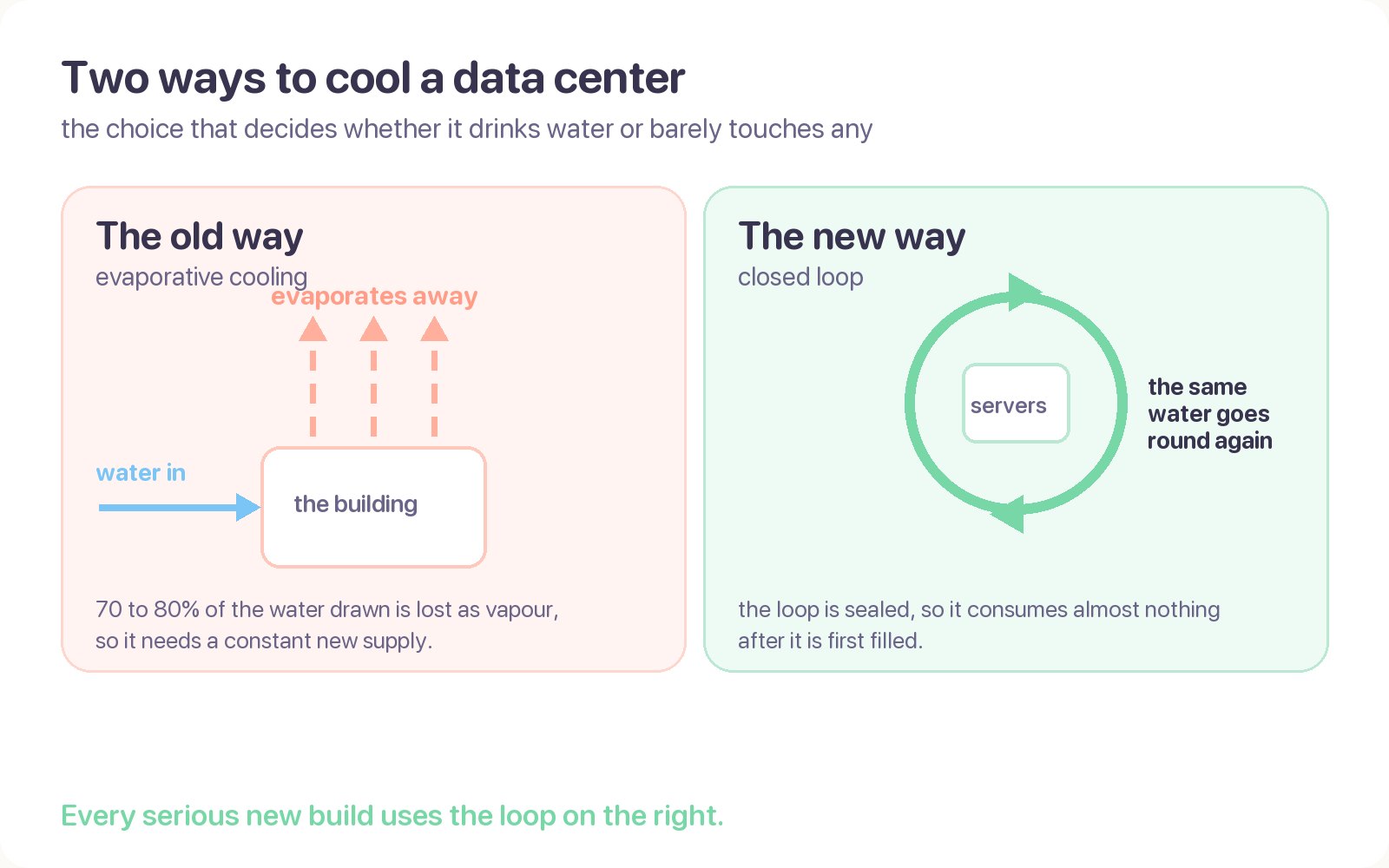
Evaporative cooling, the version in every scary headline, draws water in and loses 70 to 80 percent of it as vapour. The industry measures this as water-use effectiveness: the global average sits around 1.8 litres per kilowatt-hour, the worst hot-climate facilities reach about 9, and modern hyperscale designs run at 0.2 to 0.7. Amazon’s best sites run near 0.19, and closed-loop and air-cooled designs consume almost nothing on site.
So a data center can be a heavy water user or a negligible one. The new builds that matter, including the designs Pakistan would buy today, are overwhelmingly the second kind.
What would a gigawatt of data centers mean for Pakistan’s water?
Pakistan withdraws roughly 183 billion cubic meters of water a year (FAO AQUASTAT). Run a full gigawatt of data centers around the clock at the industry-average 1.8 litres per kilowatt-hour and you consume about 15.8 million cubic meters a year: 0.0086 percent of the national total.
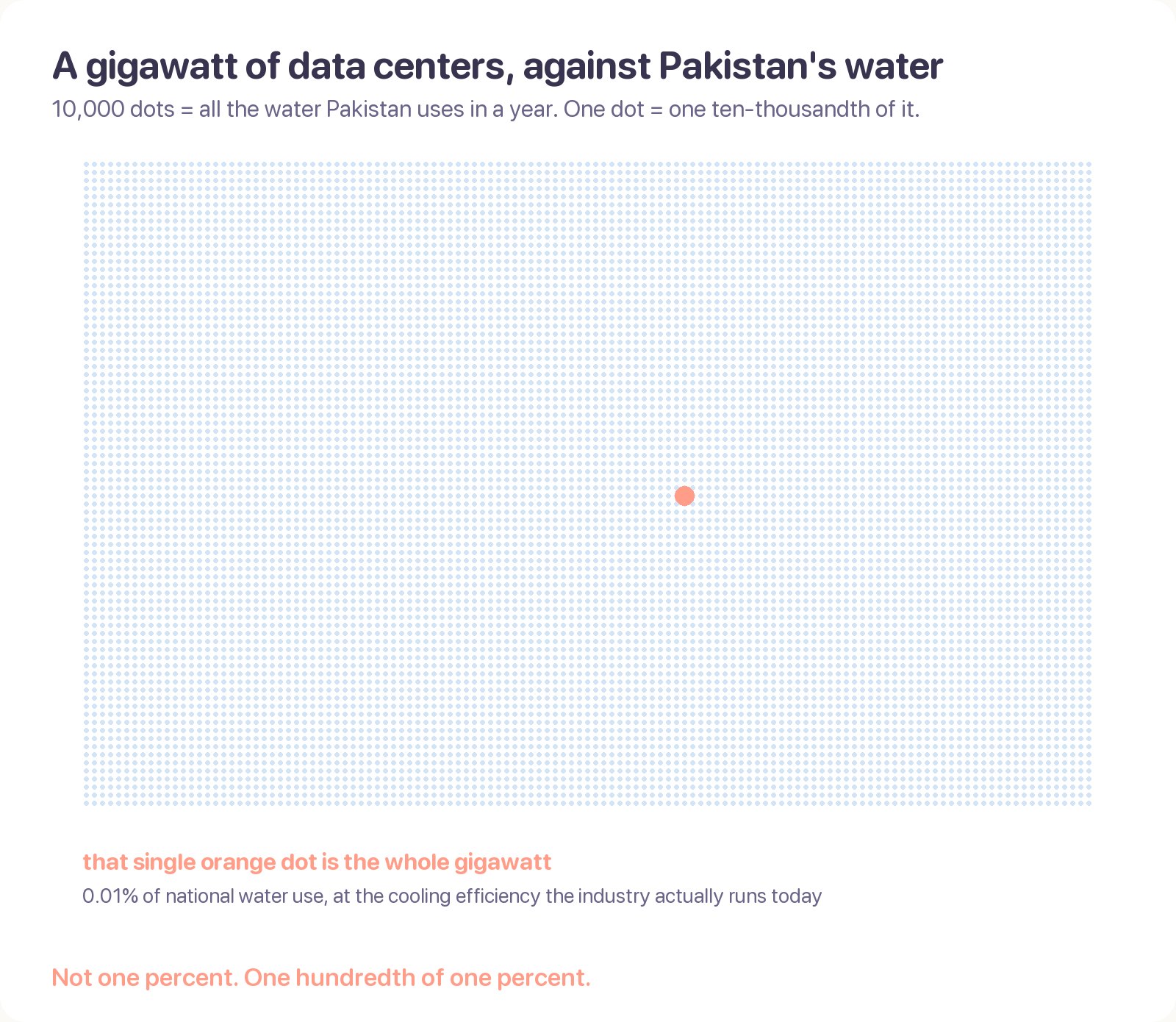
Push every assumption against the argument. Use the worst-case 9 litres per kilowatt-hour, and a gigawatt consumes about 79 million cubic meters: 0.043 percent. Count the indirect water used by power generation, which can multiply a data center’s total footprint four to ten times, and you still land near a tenth of one percent.
For a full gigawatt to consume even 1 percent of Pakistan’s water, its cooling would need to be roughly a hundred times less efficient than the industry average. The honest caveat is local, not national: a single evaporative facility can strain one city’s municipal supply if it is sited badly. That is a planning question, and it is solved by the closed-loop designs already standard in new builds.
For scale: Sky47’s Karakoram-01 is 8.5 megawatts, with headroom to reach about 50 (Data Center Dynamics, 2026). Pakistan’s entire installed base is a thousandth of the gigawatt in this calculation.
Isn’t Pakistan’s water crisis real?
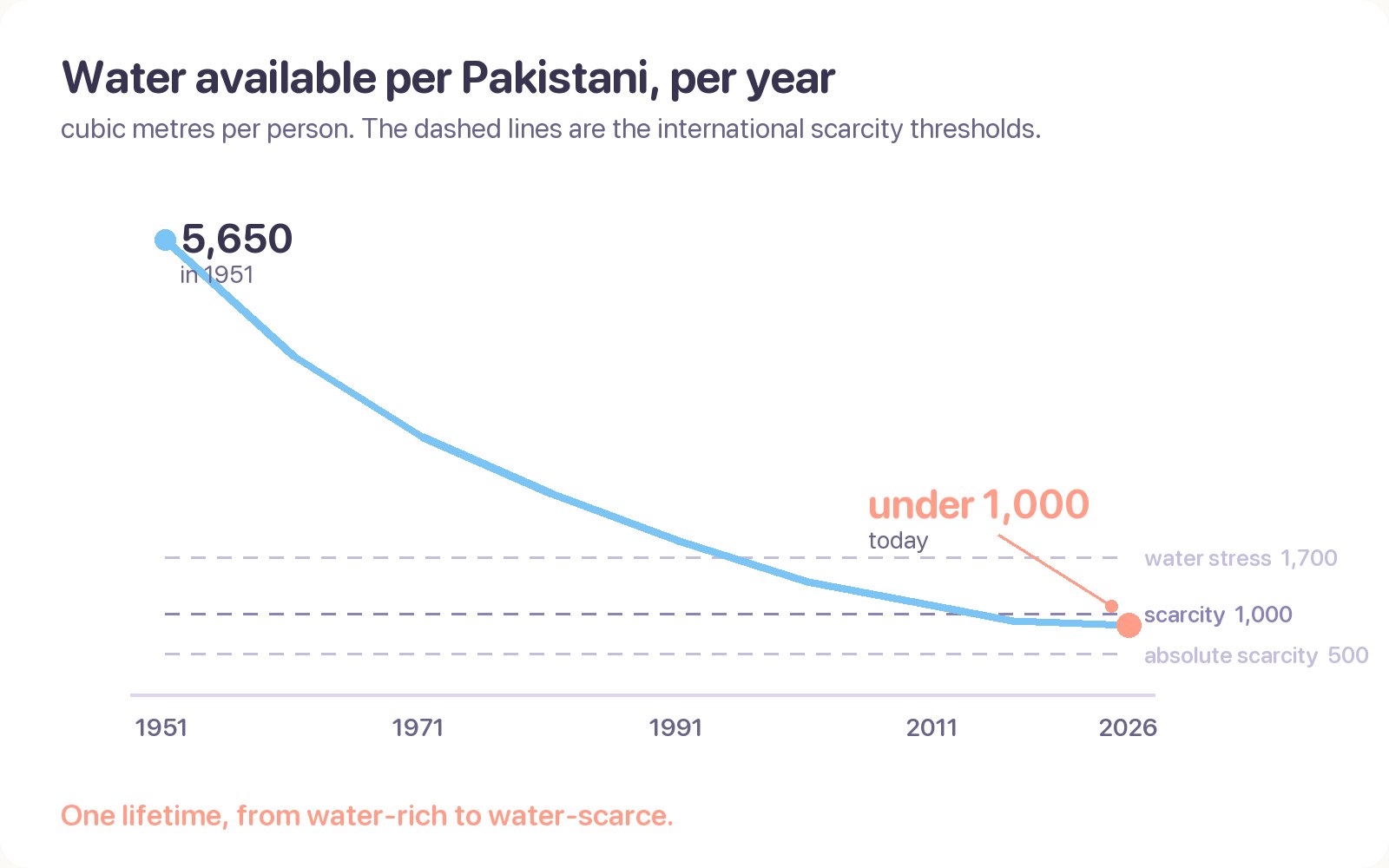
It is real, and it is severe. Per-person water availability has fallen from about 5,650 cubic meters in 1951 to under 1,000 today, below the international scarcity line (PCRWR; UNDP). But the crisis has a cause, and the cause is not computing.
Agriculture takes about 94 percent of Pakistan’s water (PIDE; FAO). The irrigation charge recovers about a quarter of what it costs just to maintain the canals (IMF, 2015), which means the country’s scarcest resource is, at the margin, free. Free water gets wasted, and it gets planted into sugarcane and rice, two of the thirstiest crops on earth. One kilogram of refined sugar embeds around 1,750 litres of water (Business Recorder, 2024).
A gigawatt of data centers at 0.01 percent is a rounding error standing next to that. I am writing a separate, full piece on water pricing, because it deserves one. The point here is narrower: the outrage aimed at data centers belongs somewhere else.
What is the real question?
The real question is who owns the intelligence. Data centers are the buildings where artificial intelligence is produced, and AI is becoming a utility: intelligence bought by the token the way electricity is bought by the unit. Whoever does not produce it will rent it, in dollars, indefinitely.
Pakistan already knows what that dependence costs. We rent our oil, about 17 billion dollars a year. We rent our gas on dollar-denominated, take-or-pay contracts. Our electricity bills carry capacity payments indexed to the dollar. Every one of those meters ticks upward when the rupee slips. Renting intelligence would bolt the same meter onto education, healthcare, and every business decision in the country, on the most important input of the next twenty years.
Meanwhile, India has committed over a billion dollars and 34,000 GPUs to sovereign AI. Saudi Arabia is targeting 1.9 gigawatts by 2030. Indonesia built its own open model in its own languages through a telco partnership. The race to produce intelligence domestically is already on, and the water panic is the noise Pakistan is making instead of entering it.
In the 1970s, Pakistan built a nuclear program the world said it could not afford, because sovereignty was worth the price. Intelligence is the next capability in that category. Not a weapon this time. A lifeline.
The full argument, including what it would cost and how a country like ours could actually build it, is the subject of my video series on sovereign AI, and it starts from the idea in my thesis: as building gets cheap, the scarce things are what protect you. Owning the machinery of intelligence is exactly that.
I worked in enterprise data for years, and I have spent this year building AI systems hands-on, so I have seen both what these facilities are and what they are not. What they are not is a threat to Pakistan’s water. Read the thesis, browse the rest of my writing, or reach out if you are building in this space. And when someone tells you the machines will drink the country dry, ask them one question: what percentage? They will not know. Now you do.
Sources
- Associated Press via Iowa Public Radio: Microsoft’s West Des Moines water use (September 2023)
- Li, Yang, Islam, Ren: “Making AI Less Thirsty,” UC Riverside (2023)
- Bloomberg: the AI boom’s water footprint, via Xinhua summary (May 2025)
- Axios Des Moines: data centers were 2 to 7 percent of local water use (2025)
- EESI: data centers and water consumption
- FAO AQUASTAT: Pakistan water withdrawals
- UNDP Pakistan: water security and per-capita availability
- PIDE: the water crisis in Pakistan
- IMF analysis of irrigation pricing, via Dawn (2015)
- Business Recorder: the water cost of sugarcane and rice (2024)
- Data Center Dynamics: Sky47 inaugurates 8.5MW Islamabad data center (2026)
Header image: Sky47’s Karakoram-01 campus, company press image via Islamabad Scene. Diagrams and charts are my own.
Keep reading with me.
One signal-dense read each week on the AI shift: narrative, taste, and distribution. No hype, no spam, no pitch.