What 5 gigawatts of AI would cost Pakistan
Pakistan's largest data center is 8.5 megawatts. Here is the real target for a country of 250 million people, the ten-year path to it, and the bill.
Pakistan’s largest data center is 8.5 megawatts. For a country of 250 million people, that is close to nothing.
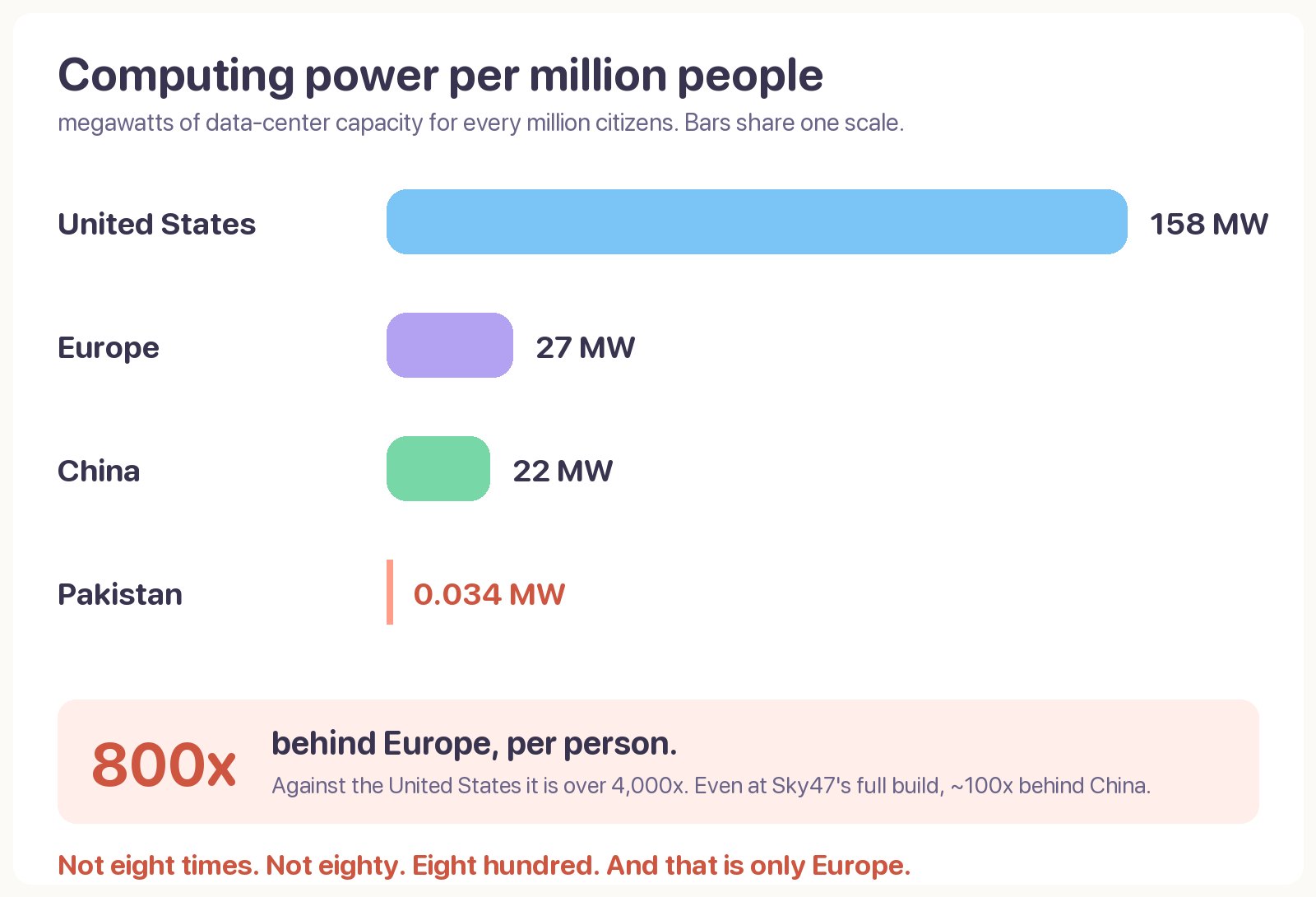
Here is the gap in one number. The United States has roughly 158 megawatts of data-center capacity for every million citizens. Europe has about 27, China about 22. Pakistan has 0.034. Even against Europe we are roughly eight hundred times behind per person. Against the United States the multiple runs past four thousand. And we stay about a hundred times behind China even if Sky47 reaches its full build.
So what is the honest target, and what would it cost? For a country our size, matching China’s capacity per citizen means about 5 gigawatts. At frontier prices that is over 200 billion dollars, against a national GDP of roughly 411 billion. That number is supposed to make you flinch. This essay takes it apart, and shows why the real ten-year bill is a fraction of it, and why it is money this country already spends.
How far behind is Pakistan, really?
Far enough that the comparison is uncomfortable. The United States runs roughly 25 gigawatts of data-center compute load. China has around 32 gigawatts of capacity. India, our neighbour, is at roughly 1.5 gigawatts and building fast.
The trajectories are steeper still. By 2030 the United States is projected to reach around 80 gigawatts (McKinsey), China above 60 (Rystad), and India roughly 5. Global data-center electricity consumption is expected to roughly double to about 945 terawatt-hours by 2030, according to the International Energy Agency.
We have been left behind before, and we spent a century paying for it. But there has never been a gap this wide, opening this fast, in a resource this important. Intelligence per citizen is about to decide which countries set terms and which countries accept them.
What should Pakistan actually be aiming for?
Gigawatts, not megawatts. Match China’s level per person and the answer is about 5.5 gigawatts. Match the United States and it is closer to 40. So I will state the target plainly: on the order of 5 gigawatts, as a ten-year national goal we work backwards from.
Five gigawatts is not a luxury. It is China-level intelligence per citizen for a country that intends to educate its children, treat its patients, run its courts, and compete in global services using AI rather than against it.
What does that cost at today’s prices?
One gigawatt of frontier AI data-center capacity costs 40 to 50 billion dollars, all in. Epoch AI’s bottom-up model puts it around 38 billion, and the Stargate project in the United States is spending roughly 500 billion for 10 gigawatts. More than half of that is not the building. It is the chips.
So five gigawatts at American sticker prices is north of 200 billion dollars. Pakistan’s entire economy is about 411 billion. One gigawatt is a tenth of everything we produce in a year.
Now let me take that number apart, because three things make the real path much cheaper. First, you compound into gigawatts, you do not buy them in year one. Second, compute prices collapse: the cost of a given level of intelligence falls five to ten times a year, so the capacity you buy in year eight will not cost what it costs today. Third, the building is cheaper here. India builds data-center shells at roughly 7 to 8.5 million dollars per megawatt, well below American cost. That discount applies to the roughly thirty percent of the bill that is construction, though not to the chips, which are priced globally.
What does a realistic ten-year build look like?
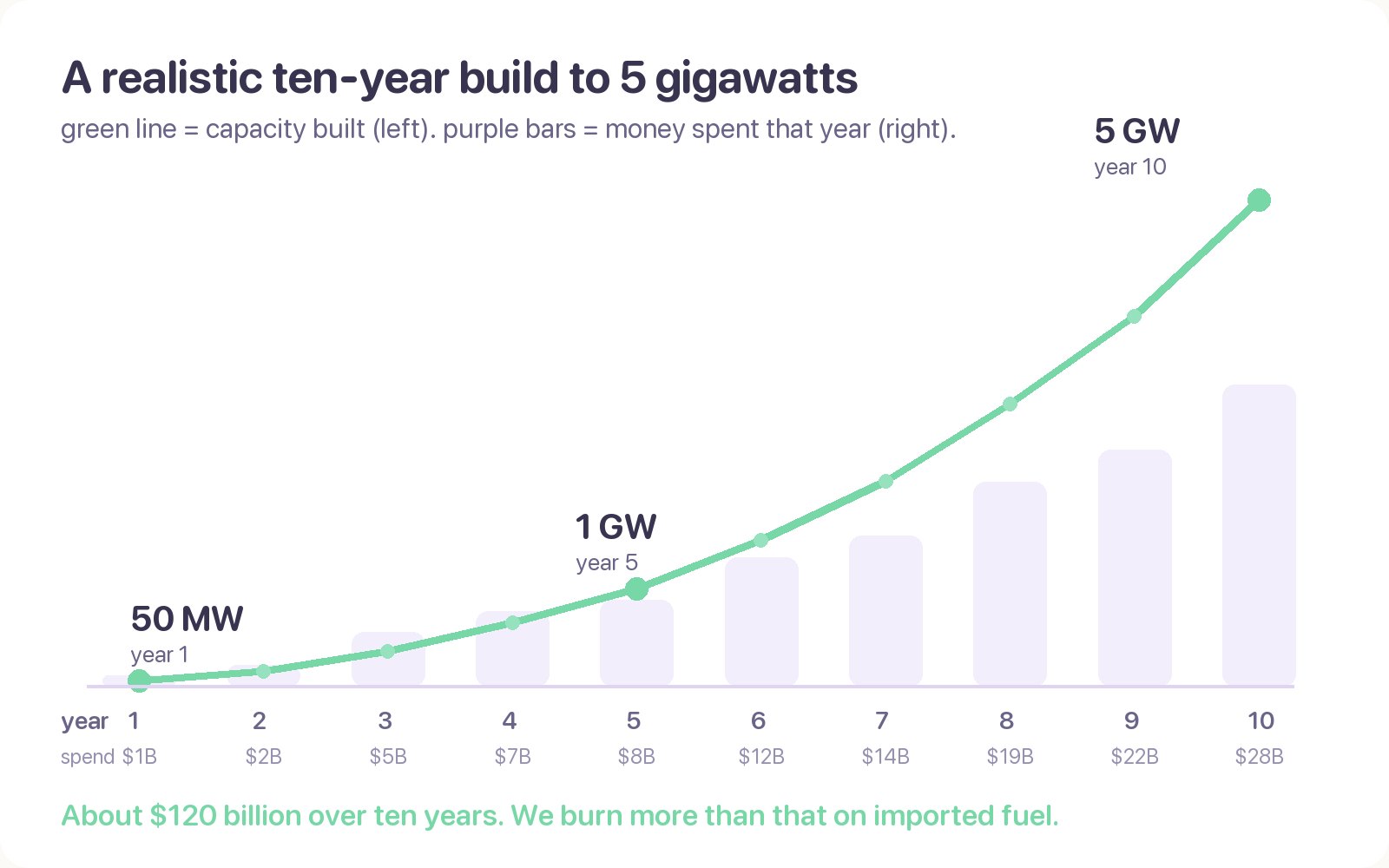
It starts small and doubles. Year one is 50 megawatts, which is Sky47’s full campus built about five times over, for roughly a billion dollars. That is achievable today with private capital, no miracles required.
Year two adds another hundred megawatts, year three another two hundred. By year five the country crosses one full gigawatt. By year ten it reaches five. Annual investment climbs from about a billion dollars into the twenties of billions, and the decade totals somewhere on the order of 120 billion dollars.
The shape matters more than the decimals. This is a curve, not a moonshot, and each year’s capacity earns revenue that helps fund the next.
Where would the money come from?
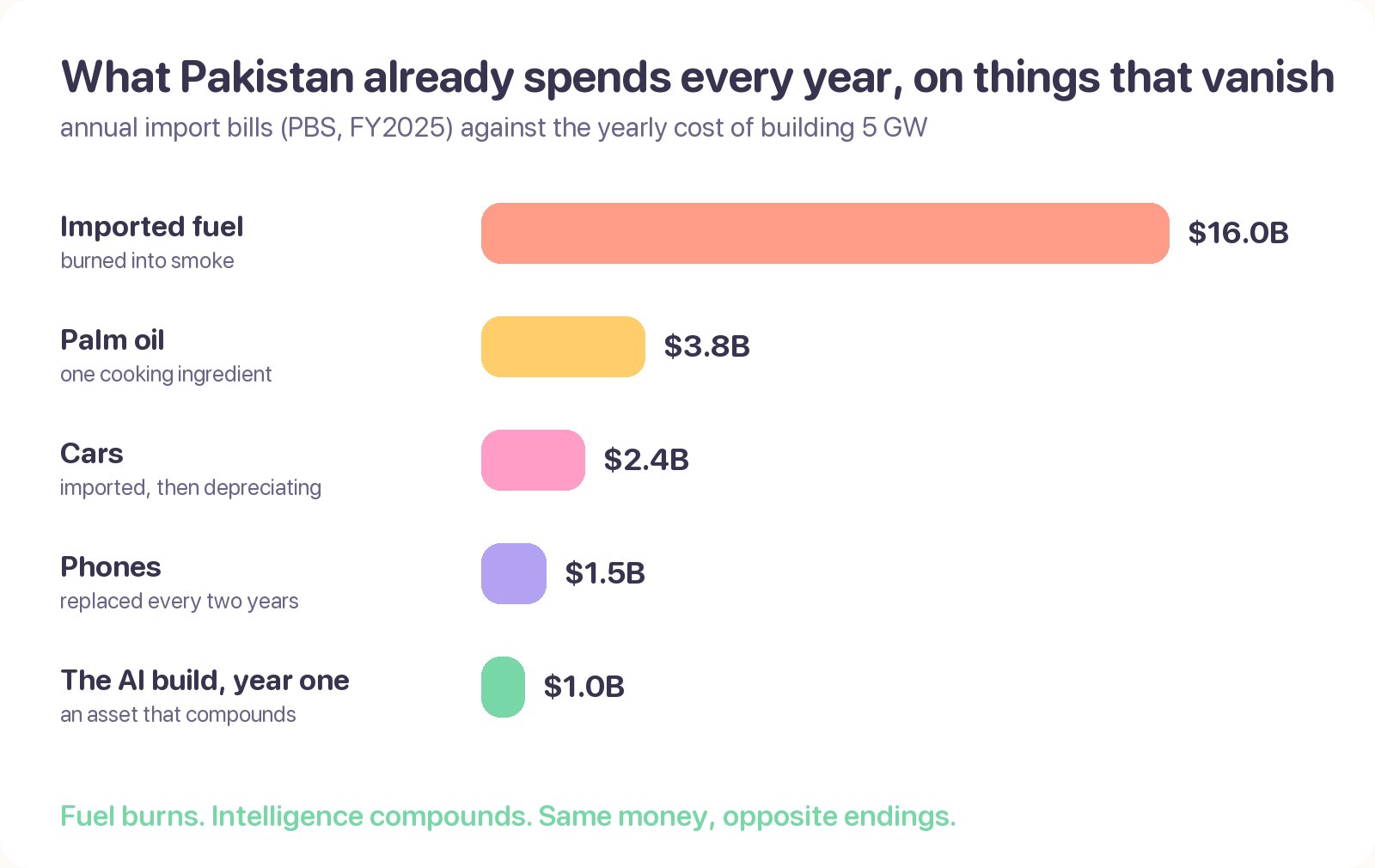
From what we already burn. Every year Pakistan spends about 16 billion dollars importing fuel, and then sets it on fire. Over ten years that is 160 billion dollars, more than the entire buildout, converted into smoke.
We spend nearly 3.8 billion dollars a year importing palm oil, a record, on one cooking ingredient. Around 2.4 billion on vehicles and 1.5 billion on mobile phones that get replaced every two years. In 2022 the government itself estimated that roughly 6 billion dollars a year was leaking out on non-essential luxury imports, and briefly banned them (Pakistan Bureau of Statistics; Dawn).
So do not tell me the money does not exist. We find it every single year. We spend it on things we consume and discard. The plan I am describing costs comparable money, and at the end of it we own an asset that compounds instead of an ash pile. Fuel burns. Intelligence compounds. That is the whole argument in four words.
On financing, the honest constraint is not the sticker price. It is the cost of capital against a fast-depreciating asset. The chips are obsolete in three to five years, so any debt has to clear before the hardware does. American operators borrow at around 11%, and a Pakistani borrower pays a sovereign premium on top. That rules out expensive merchant debt and points to the models already appearing here: industry consortiums, captive power, and vendor partnerships. Gul Ahmed and Huawei are building Pakistan’s largest conventional data center right now for 230 million dollars with its own 136 MW captive plant. Add Gulf capital looking for yield, and a diaspora sending home 41 billion dollars a year that currently buys plots and plazas, and the first few hundred megawatts are financeable without a single sovereign guarantee.
What happens if we do not build it?
We become the textile industry of intelligence. Pakistan’s IT sector sells services. Say you sell a hundred dollars of AI-era services to a foreign client. If the intelligence underneath is rented from abroad, then sixty dollars leaves immediately as compute cost, more leaves as tooling and cloud, and what actually stays here is a few dollars. It books as a hundred dollars of exports. It is really three.
We have watched this film before. Fifty years as the low-margin stitching floor of the world, importing the machines and the inputs, keeping the scraps. Own the stack instead, and that same hundred dollars stays, circulates, and hires people here.
Every industrial revolution has split the world into two groups: the countries that built the new machine, and the countries that rented it. The builders set the terms. The renters served, and some of them are still serving.
In the 1970s Pakistan built a nuclear program the world said we could not afford, because sovereignty was judged worth the price. This costs less relative to what we have, and it matters more, because a bomb only protects a future while this one builds it.
Five gigawatts. Ten years. Industry-led. That is the plan, and I would rather be argued with than agreed with, so tear the numbers apart. But nobody gets to say there is no plan.
This is the fourth part of a series. Start with whether data centers threaten our water, then the dollar trap, then owning the stack. My thesis sets out the wider argument, and you can reach me here.
Sources
- Data-center capacity by country and 2030 projections, McKinsey
- Global data-center electricity to 2030, International Energy Agency
- China’s data-center capacity outlook, Rystad Energy
- India’s data-center capacity, CBRE
- AI data-center cost breakdown, Epoch AI
- Stargate: $500 billion for 10 gigawatts, OpenAI
- Global data-center capex to 2030, McKinsey
- AI hardware price-performance trends, Epoch AI
- Sky47’s 8.5 MW Islamabad facility, Data Center Dynamics
- QGDC and Huawei’s $230 million Pakistani data center, Business Recorder
- Pakistan’s import bill by category, FY2025, Pakistan Business Council reproducing PBS data
- Record palm oil imports, FY2026, ProPakistani
- The 2022 luxury import ban and its estimated saving, Dawn
- Record remittances, State Bank of Pakistan
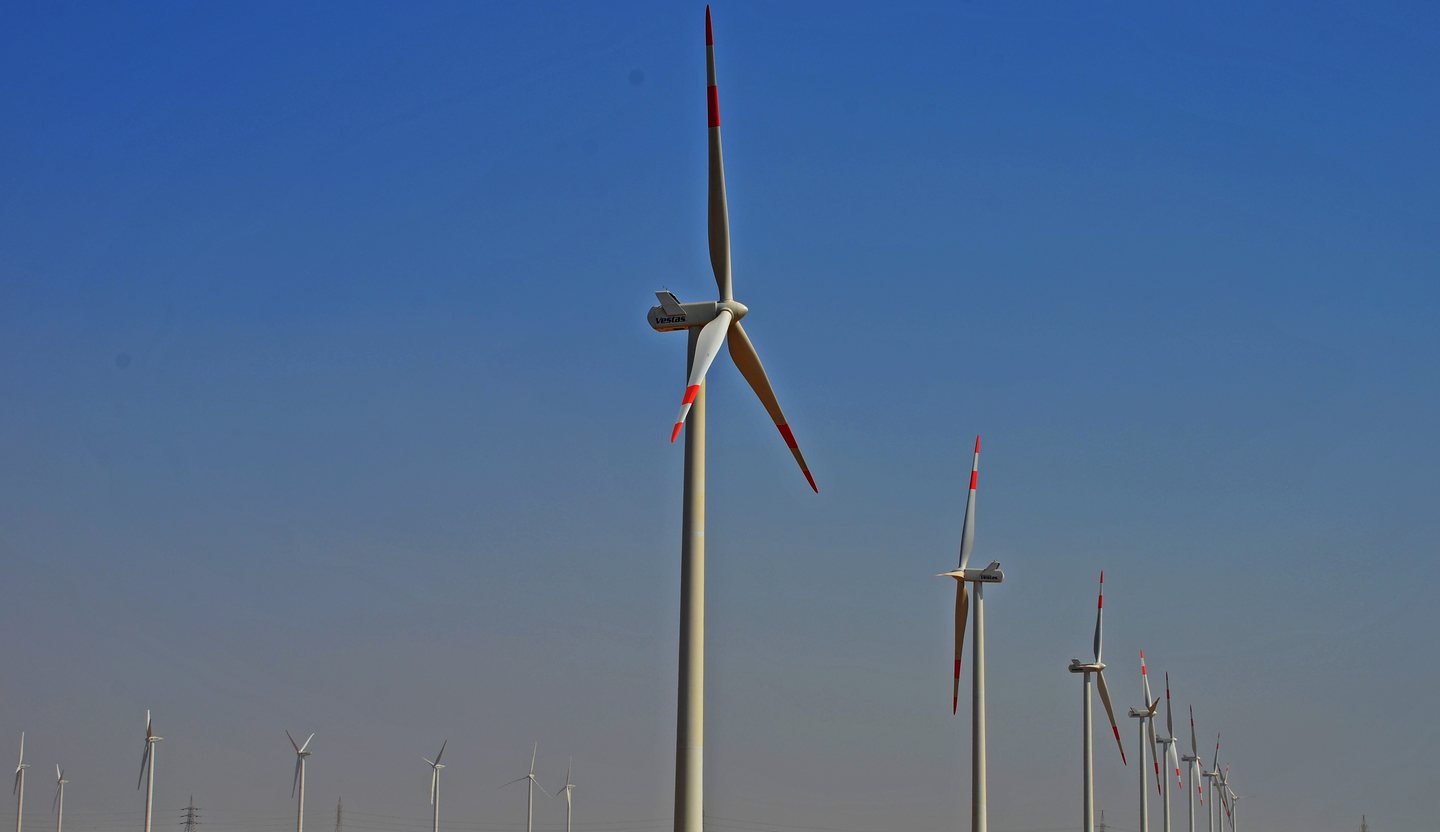
Hero image: Jhimpir wind farm, Sindh, by Muzaffar Bukhari, CC BY-SA 2.0.

Keep reading with me.
One signal-dense read each week on the AI shift: narrative, taste, and distribution. No hype, no spam, no pitch.