Pakistan never paid for water. That is the crisis.
Say we should price water and watch the room explode. But free water is exactly why we keep running out of it, and the numbers are not close.
There are four words you can say in Pakistan that will make a room lose its mind. We should price water.
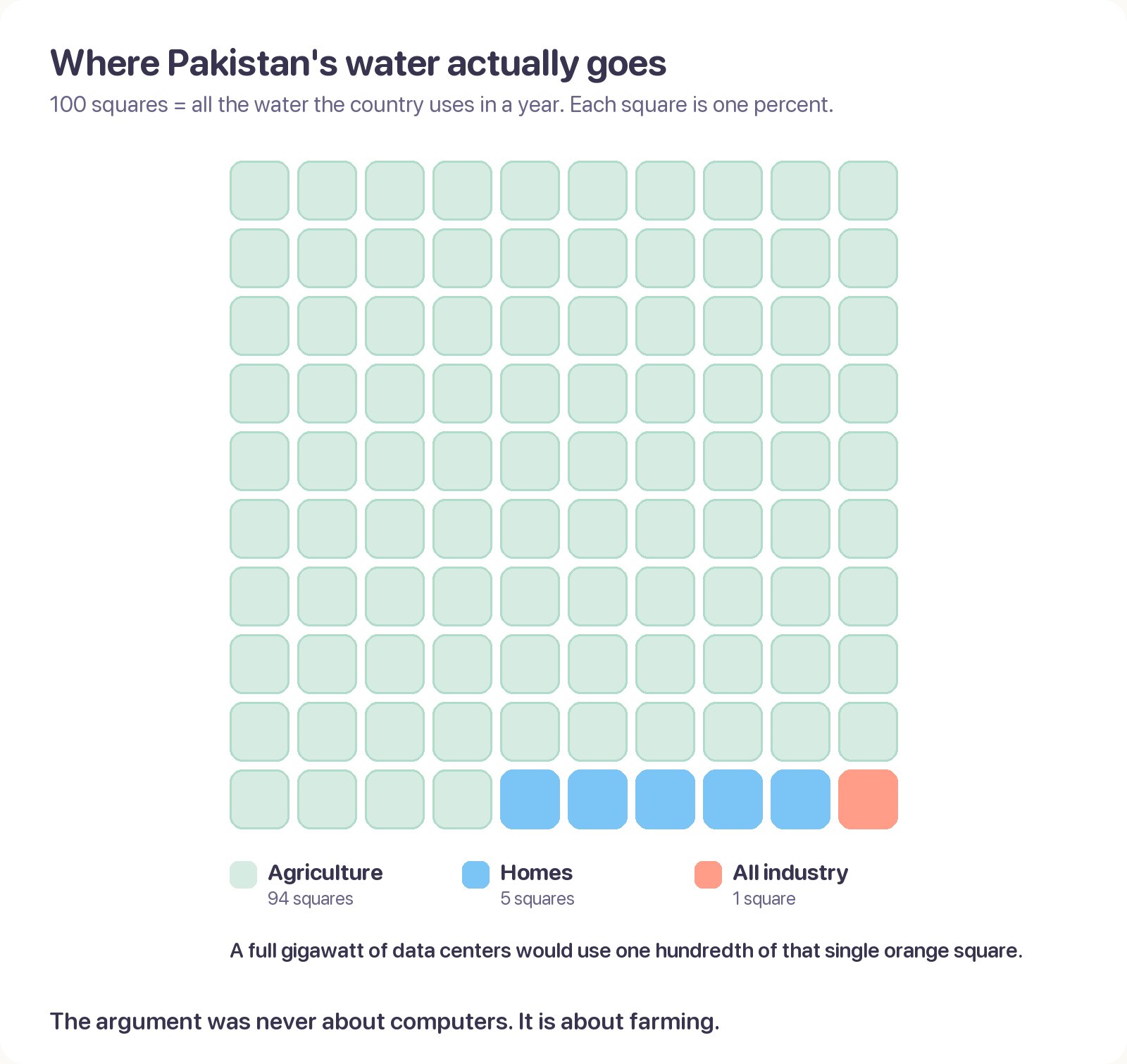
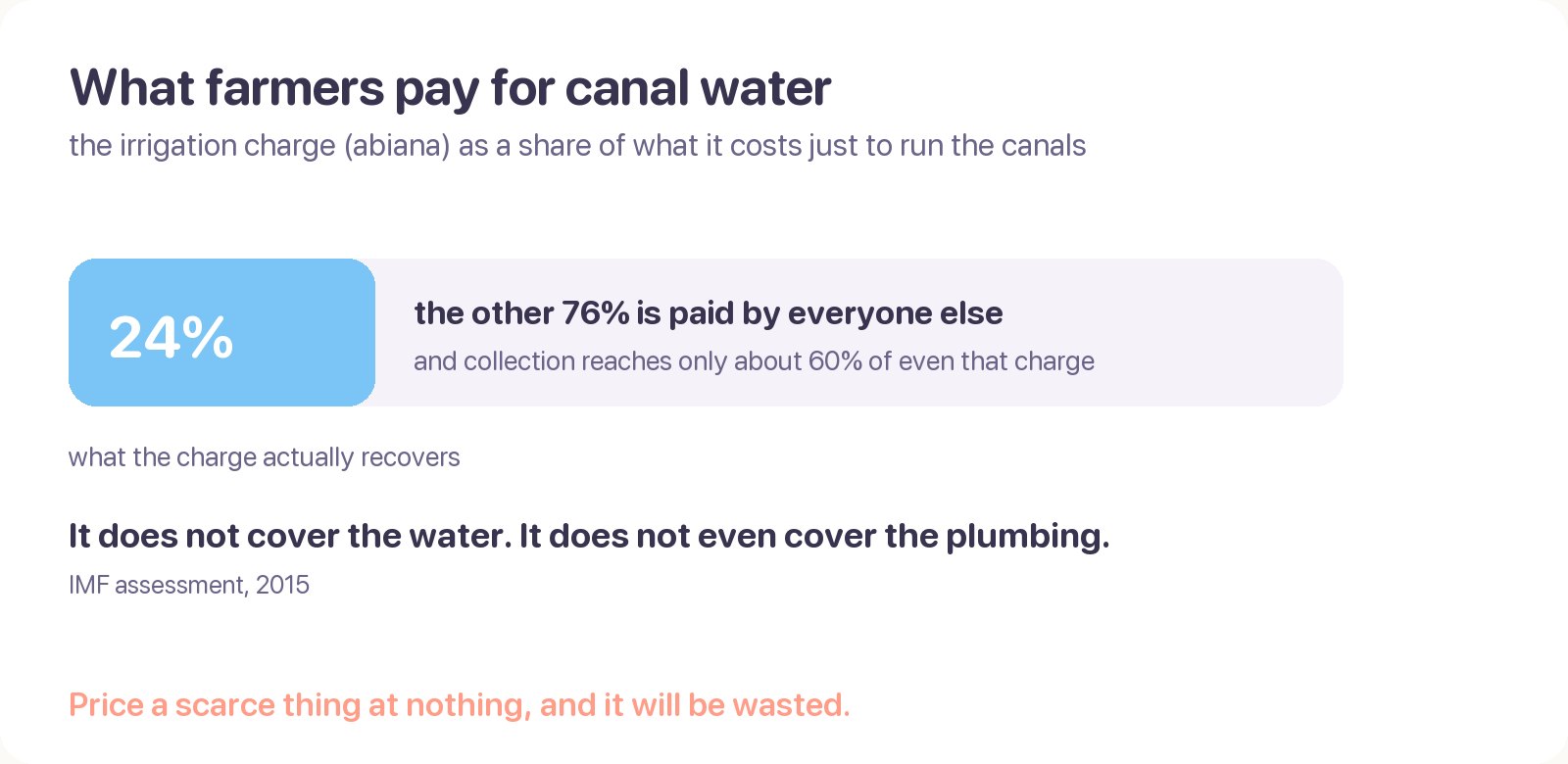
I am going to defend those four words, because the arithmetic is not close. Agriculture takes about 94% of this country’s water. Homes take around 5%, and all industry combined takes under 1% (PIDE, FAO). The charge farmers pay for canal water recovers roughly a quarter of what it costs merely to operate the canals, according to an IMF assessment, and it is levied per acre rather than per litre, so using more costs nothing extra.
Meanwhile per-person water availability has fallen from about 5,650 cubic metres in 1951 to under 1,000 today, below the international scarcity threshold. We are not running dry because of computers, or factories, or showers. We are running dry because the scarcest thing we own is, at the margin, free.
Is a price on water really the answer?
A price is not greed. A price is information. It tells an entire economy that a thing is scarce and should be used where it is worth the most. Nothing of value should be free, not because someone must profit, but because free things get wasted. That is not ideology, it is human nature. What costs nothing gets treated as nothing.
And we have already lived this exact lesson with a different resource. We had our own natural gas, we kept it artificially cheap, and roughly 80% of Pakistani cars ended up running on CNG, second only to Iran. We burned through domestic reserves and by 2015 we were importing LNG from Qatar in dollars on take-or-pay contracts. Underprice a scarce thing, and you will waste it, and then you will import it. I wrote about that cycle in the dollar trap.
Now watch the same story play out in water, except there is no import option for a river.
Where does Pakistan’s water actually go?
Overwhelmingly to farming. Pakistan withdraws roughly 183 billion cubic metres a year (FAO AQUASTAT), and agriculture takes about 94% of it. Every home in the country, all 250 million of us drinking, washing and cooking, accounts for around 5%. All industry combined is under 1%.
So when we argue about Pakistan’s water, we are not really arguing about cities or factories. We are arguing about agriculture, and everything else is a rounding error wearing a costume.
What do farmers actually pay for canal water?
Close to nothing, by design. The charge is called abiana, and the IMF found in 2015 that it recovers only about a quarter of the annual operating and maintenance costs of the system, with collection reaching roughly 60% of even that small amount.
Read that again. We charge so little for water that we cannot pay for the plumbing that delivers it, let alone value the water itself.
It gets worse in a way that matters enormously. Abiana is charged per acre, on a flat crop basis, not by volume. So a farmer who floods his field pays the same as a neighbour who drips every litre carefully. There is no financial reason to save a single drop. The price signal does not exist, and then we act surprised when the resource is squandered.
Why does a water-scarce country grow sugarcane?
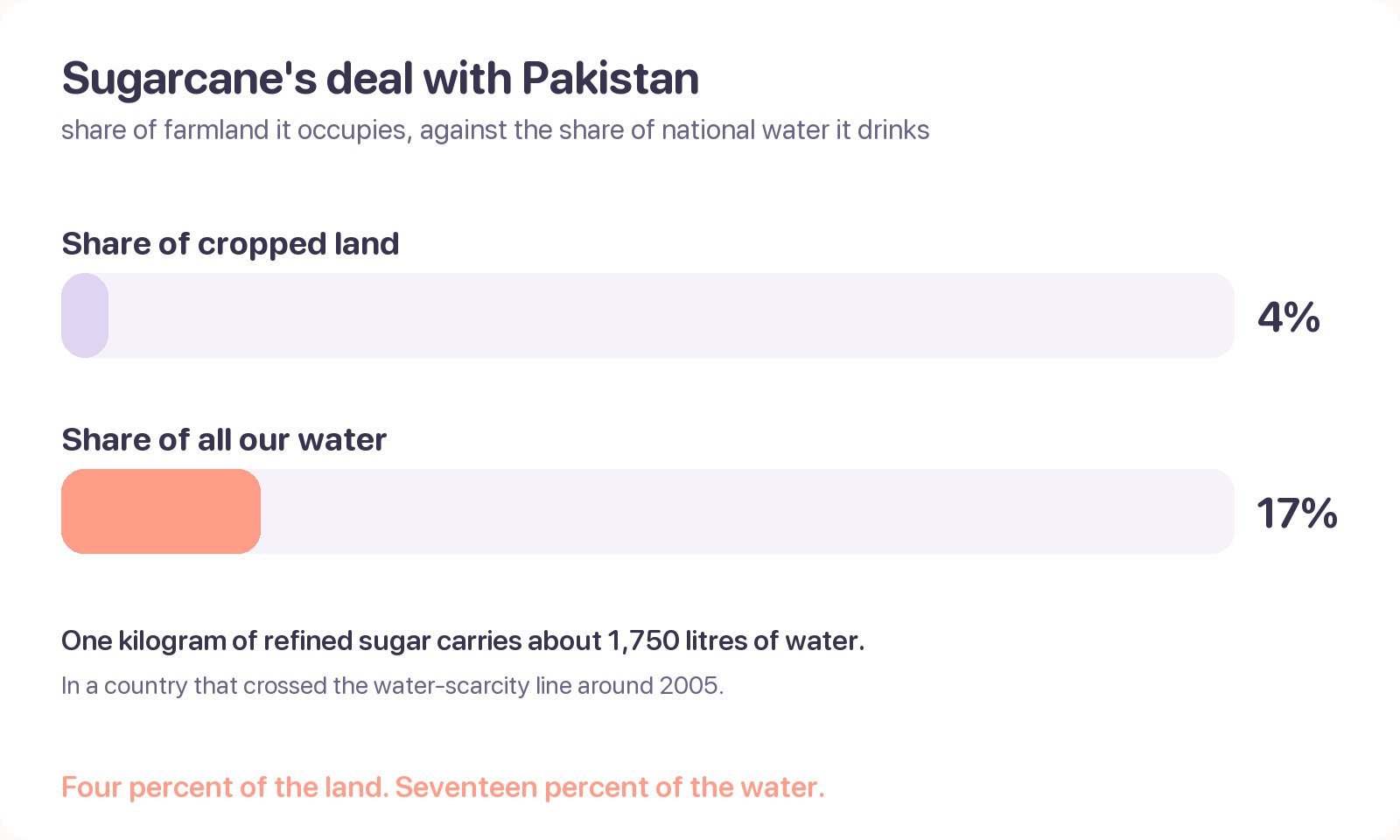
Because the water is free and the crop is protected. Producing one kilogram of refined sugar carries around 1,750 litres of water, and Pakistani sugarcane is less water-efficient than the global average. By one industry estimate, sugarcane occupies about 4% of our cropped land while drinking roughly 17% of national water.
Rice tells a similar story from the other direction. We export around four million tonnes a year, which is millions of acre-feet of Pakistani water, loaded onto ships and sent abroad permanently. We are not only exporting rice. We are exporting water, at a discount, from a water-scarce country, and counting it as an export success.
Why would anyone do this? Because the inputs are mispriced and the outputs are protected. The government’s own Sugar Inquiry Commission in 2020 found mills underreporting production and committing fraud, and documented roughly 29 billion rupees in export subsidies over about five years. The commission named the owners, and they are among the most powerful political families in the country. Reporting has long noted that a few dozen families dominate the industry.
Follow the chain and the machine is obvious. Free water, plus a guaranteed support price for the thirstiest crop, equals a permanent mechanism for converting the nation’s scarcest resource into private fortunes. The farmer is not the villain here. He is responding rationally to the prices in front of him. The prices are the crime.
What about the Gulf farming deals?
They are the same giveaway, at a larger scale, with better branding. Pakistan has been leasing state land for corporate farming through the Special Investment Facilitation Council, with roughly 4.8 million acres identified and up to 6 billion dollars sought from Gulf states. It is announced as foreign investment and applauded.
Look at what is actually being sold. The land is leased. The water, our scarcest resource, flows onto those fields at the near-zero rate described above. The crops are then partly shipped out. The managing director of the flagship army-linked farming company said on the record that around 60% of the crops target domestic food security and “the remaining 40 percent would be exported mainly to Gulf countries,” citing a first export order of 25 million dollars.
Water-rich countries selling food to water-poor countries is the natural order of trade. We have arranged the opposite: a water-scarce nation quietly subsidising the food security of the desert. Price that water properly and one of two things happens. Either the deal still makes sense and Pakistan finally gets paid for its scarcest resource, or the deal stops making sense and we keep the water. Both outcomes are better than today.
So what about the data centers?
This is where I started this series, and the comparison is almost comic. A full gigawatt of AI data centers, more than a hundred times everything Pakistan has today, would use about 0.01% of national water. Sugarcane uses an estimated 17%.
One is a rounding error that produces the defining resource of the next century. The other is roughly a fifth of our water, converted into a subsidised crop we would be better off importing. Yet the national outrage went to the computers, as I showed when I worked through the actual water math on data centers.
That is what an unpriced resource does to a country’s thinking. It makes us fight about the wrong user, because the right one is politically untouchable.
What would honest reform look like?
Protect the household lifeline and price the waste. Domestic use is around 5% of the total and was never where the waste lived, so a basic block of water for every family should stay cheap or free. That is not the problem and pretending otherwise is how this conversation gets derailed.
Then move irrigation from a flat per-acre charge toward volumetric pricing, so using more water costs more money. Start with the export-oriented corporate farms, where the political resistance is lowest and the giveaway is largest. And note how modest the initial ask really is: the IMF benchmark is about recovering canal upkeep, not extracting rent from farmers.
Free water sounds like compassion. In practice it has functioned as a transfer from the many to the few, and the drought you feel in your tap is the receipt. Water is life. That is exactly why it cannot be free.
I know this one will start arguments, and I want it to. Some conversations only move when somebody says the unsayable part out loud. Read my thesis for the wider argument about what protects a country when everything gets cheaper, browse the rest of my writing, or tell me where I am wrong.
Sources
- Water withdrawal by sector in Pakistan, PIDE
- FAO AQUASTAT water-use methodology and country data
- Per-capita water availability and the scarcity threshold, UNDP Pakistan
- IMF on abiana recovering a quarter of operating costs, via Dawn
- The water cost of sugarcane and rice, Business Recorder
- Water-use efficiency in sugarcane production, PIDE
- Sugar Inquiry Commission findings, Dawn
- The political anatomy of the sugar industry, The News
- SIFC corporate farming and land allocation, The News
- Corporate farming export targets, quoted by the operator, Arab News
- CNG adoption and the gas policy failure, Gulf News
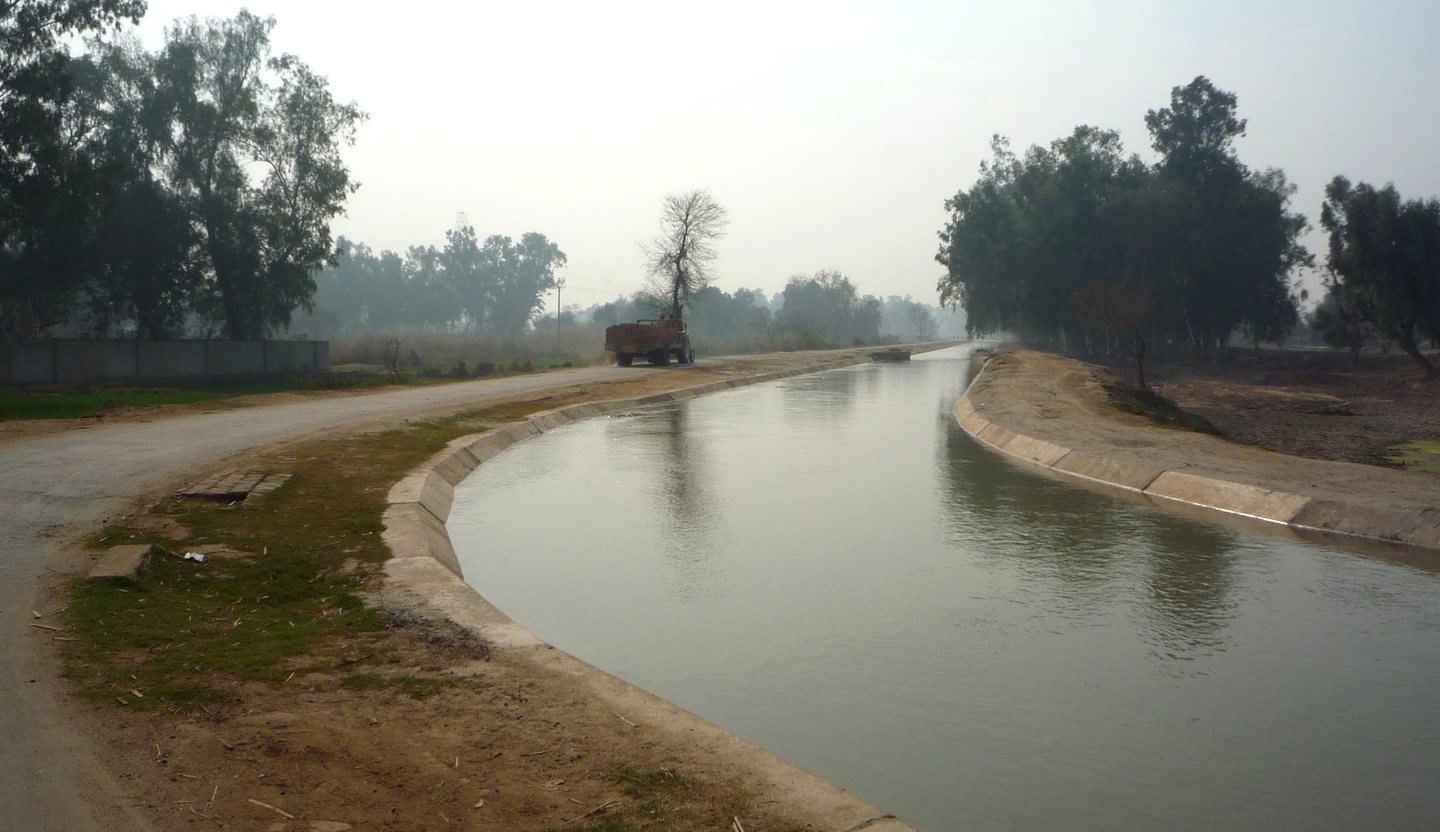
Hero image: irrigation canal near Faisalabad, by PSSP, CC BY 2.0, adjusted for brightness.
.jpg)
Keep reading with me.
One signal-dense read each week on the AI shift: narrative, taste, and distribution. No hype, no spam, no pitch.