Thought Behind Things · Jun 16, 2026
SpaceX's IPO is a pump. The space industry is real.
Muzamil reads the SpaceX IPO line by line: a 2 trillion dollar valuation on 18 billion in revenue and a 5 billion dollar loss, the index-fund rule that forces the buy, and why the real value is the hundred startups underneath.
9 min read
A trillion-dollar headline, and a confusing narrative
The episode opens with a number designed to stun. SpaceX listed in a roughly 1.75 trillion dollar IPO, raised about 75 billion dollars, and closed its first Friday at a valuation over 2 trillion. The stock opened near offer and rose roughly 20 percent by the end of the day. Elon Musk emerged, in the headlines, as the world’s first trillionaire.
Muzamil is candid that this is not his usual beat. He admits he does not follow SpaceX closely. But the headlines reached everyone, and so did the noise. “जो narrative है वह unfortunately बहुत ही confusing सा हो चुका है,” he says — the narrative has become genuinely confusing. People are celebrating trillionaires and enormous investment without asking the basic questions. His purpose across the hour is to slow that down and read the thing line by line.
He starts from first principles. An IPO is how a private company comes to ordinary investors and offers a slice of itself. You buy the piece, you own it, and you make money later through the share price or dividends. Crucially, the initial 75 billion is not returned to investors — SpaceX keeps it to fuel growth. That distinction matters for everything that follows.
The number that doesn’t work
Then comes the table. Muzamil walks through the most valuable companies in the world and reads out their economics, one by one, because the comparison is the whole argument.
Nvidia: roughly 4.5 trillion in value, 130 billion in revenue, 72 billion in profit — a margin around 60 to 65 percent. Apple: 416 billion in revenue, 112 billion profit. Alphabet: 400 billion revenue, 132 billion profit. Microsoft: 281 billion revenue, 100 billion profit, margins past 30 percent. Amazon: 700 billion revenue, 77 billion profit. Saudi Aramco, Meta — all of them anchored by real earnings.
Against that wall of profit, he places SpaceX. Revenue of 18 billion dollars. A loss of about 5 billion last year. Investors put in 5 billion in additional money just to keep the company running. The price-to-earnings ratio, he notes, is not merely missing — it is negative.
“एक company जिसकी ना कोई revenues हैं, ना कोई profitability है,” he says — a company with no real revenues, no profitability, nothing it has proven, carries a next-level valuation. How is that possible? He is careful here. He is not claiming an answer yet. He is insisting the question can at least be asked.
The math gets sharper. The US market’s healthy long-run average is around a 25 price-to-earnings ratio — inflated versus the rest of the world, but stable. To reach that, SpaceX would need to show 70 billion in profit. On 18 billion of revenue, that means growing revenue fivefold and making every dollar of it pure profit. “That almost sounds like an impossibility,” he says, and lets it sit.
The Musk machine: X, xAI, and a chain of conversions
To explain why SpaceX, and why now, Muzamil tells the story of the other companies. He is careful to give credit. Elon Musk built the electric-car revolution, made reusable rockets, beamed internet from the sky. The Model Y was, he notes, the world’s best-selling vehicle last year.
But Tesla itself trades at a 371 price-to-earnings ratio — its own bubble, he says, deserving its own video. And he sets a marker against the maximalists: Tesla is valued at 1.27 trillion while BYD sits at 122 billion, ten times less, even as BYD builds its base across the emerging markets that are the customers of the next twenty years and Tesla leans on US government protection.
Then the chain. Musk bought X with loans and powerful co-investors — Peter Thiel, Andreessen Horowitz, multiple Saudi princes. X’s value collapsed after the purchase. He launched xAI into the AI narrative, but xAI could not compete with Anthropic, OpenAI, or Google. The over-hyped company deflated. Investors who put money into a social network were left holding shares that had been converted, dollar-free, from X into xAI — paper, sitting in a drawer.
“Investor का पैसा, investor की जो stockholding है वह irrelevant है अगर वह उनकी जेब में पड़ी हुई है,” Muzamil says — an investor’s holding is irrelevant while it sits in their pocket. The only way to make money is an IPO, when shares float on the open market and can finally be sold. Tesla, under public scrutiny, could not absorb a company burning twelve billion a year. So the exit had to come from somewhere else.
SpaceX as the exit vehicle
SpaceX, Muzamil argues, became the door. Its investors are not only powerful — they are directly connected to the current ruling government of the United States. A clean, exciting, smaller company with Starlink as a genuinely profitable business and space as the next frontier. The narrative writes itself.
So the structure folds the boom inward: SpaceX absorbs xAI, the X investor’s stake converts again, and now someone who came to buy a social network sits holding shares of a rocket company. “जो कि social network ख़रीदने आया था. आज वह एक rocket company ख़रीदकर बैठा हुआ है,” Muzamil says. The money went into a social network; the share is in a rocket company; and the investor, three or four years in, just needs an exit.
He layers a fresh narrative on top — tying the AI boom to space, trying to construct a space boom that investors are not yet excited about, because space is complicated and technical and never caught the frenzy AI did.
The satellite-compute fantasy, by the numbers
This is where Muzamil does the engineering arithmetic the hype skips. The pitch is satellite-based data centers. A one-gigawatt data center, he calculates, would need roughly eight thousand satellites. A Starship carries about eighty satellites and costs around 100 million dollars per launch. Transport alone for one gigawatt’s worth runs to about 10 billion dollars — half of SpaceX’s total revenue — and Starship has not even formally launched.
Even handed that 10 billion, the physical capability to put eight thousand satellites up in a single year does not exist, and synchronous data centers are what the compute actually requires. “So there are very clear constraints in this plan,” he says. The economics and the practicality both carry large question marks.
The real game: index funds and the forced buy
The mechanics are where the episode turns from skepticism into a thesis. Muzamil explains who buys IPO stock and why this one is rigged toward retail.
Normally about 10 percent of shares go to retail investors; for SpaceX it was 30 percent. Retail is more volatile, more emotional, so companies prefer institutions first. A 30 percent retail allocation, he reasons, signals that the sophisticated Wall Street money was not interested — so they turned to retail and built a narrative.
Then the index funds. Funds tracking the Nasdaq 100, S&P 500, and Russell 1000 manage trillions in pension and retirement money — money that, as he puts it, gets invested “आंखें बंद करके,” eyes closed, automatically, into whatever the index holds. Historically a new IPO waits a year for price discovery before joining an index. But just before this IPO, Nasdaq changed the rule for big-cap companies: they can be added after fifteen days. Once added, “trillions of dollars of funds will be forced to buy SpaceX share,” regardless of price.
And the float rule was inverted too. The minimum-float rule exists to stop exactly this — showing a huge valuation off a tiny float. Yet for companies floating under 10 percent, Nasdaq said it would grant triple weighting. So SpaceX floating around 4 percent gets counted as 12. The rule built to prevent the scenario now enables it.
Who is left holding it
Muzamil names the outcome plainly. “वो आहिस्ता आहिस्ता जितने भी अमीर insiders हैं वह अपना सारा stock dump करें आप मुझ जैसे बेवकूफ लोगों के ऊपर” — slowly the rich insiders dump their stock onto fools like me, and eventually a crash arrives where the wealthy stay set and the poor sit out the next decade. He points to 1929, and to the pattern repeating.
Why now? Because IPOs are out there for retail, and the target is whatever money is left — retirees’ money. When it crashes, the retiree has the problem, the average American is trapped, the retail investor worldwide is trapped, and the old investor has already been cashed out.
On Musk himself, he is fair and unsentimental. Musk is not liquidating; his trillion-dollar figure is an inflated paper valuation across his companies, not cash. Muzamil personally believes it will correct — perhaps an 80 percent crash to a 200 billion net worth, at which point Musk is still worth 200 billion. “I’m not that Elon maximalist,” he says. He thinks Musk wants to be a visionary and gambled his entire net worth on it. The companies are not going anywhere; they are simply overly inflated. He notes, too, that Peter Thiel has moved to Argentina, bought a home, moved his children.
What Pakistan should actually take from this
By the end, the point lands where the arc thesis always lands: separate the technology from the finance. The valuations are noise. The industries underneath are real.
He invokes the parallel that drives him. India understood the IT boom early, sent its people into Apple, Meta, Google, and Microsoft, and now exports 300 billion dollars of IT. “They were just early. They just knew what to study and they just knew where to get access to the right knowledge.” The same knowledge is now coming for space and robotics.
So his instruction is precise. “हमने SpaceX को नहीं देखना. हमने अगली सौ startups को देखना है जो कि space के अंदर खुल रही हैं” — don’t watch SpaceX, watch the next hundred startups opening inside space. Place engineers from the aerospace and engineering institutions into those companies, into core AI, into robotics — in China, America, or Europe — so that in ten years they grow, bring institutional knowledge home, and build the base that sets up the next 25 million and the next 250 million.
He is honest about the obstacle: a low-trust, FOMO-driven society chasing immediate returns, where asking someone to trust a ten-year horizon is hard. And he closes on the historical proof that timing is everything — Amazon lost roughly 90 percent of its value when the bubble burst in 2001 and is now among the most valuable companies in the world. The real value, the real jobs, the real industry get created only after the hype dies and the dead money leaves. That, he says, is when you enter.
It is half past four in the morning when he ends, tired, energy spent — and clear that the noise is the trap, the underlying is the opportunity.
More from Thought Behind Things
Jun 20, 2026
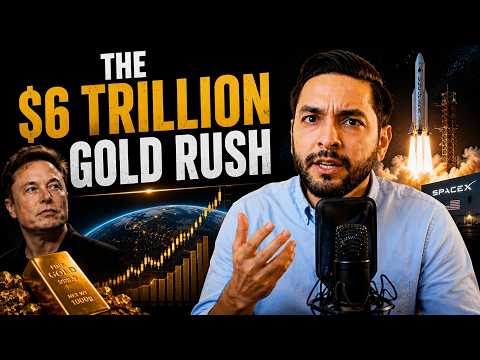
The space economy's real wealth is in the startups under SpaceX
Muzamil reads the space-tech decade through one variable: the falling cost of reaching orbit. As that number drops, hundreds of companies and millions of jobs open up beneath the headline names.
Listen →
Jun 9, 2026
How Asad Mehmood landed Mattermost from Pakistan before A levels
with Asad Mehmood
Asad Mehmood walked into Mattermost before he had A levels, crossed two million dollars on Upwork, and now runs a design agency from Pakistan. He sat with Muzamil to lay out the framework underneath it: become undeniably good, then become visible, then sell outcomes.
Listen →
Jun 6, 2026
The illusion of Islamic finance, and a $2M CEO
Muzamil unpacks Pakistan's pre-budget mood — IMF pressure, a salaried class taxed five-fold in five years, freelancers in the crosshairs, and a 'shariah-compliant' bank paying its CEO two million dollars a year off the back of fiat rupees.
Listen →Never miss what's next.
The dispatch - new writing and conversations, straight to your inbox.
First name, last name, email - in your inbox weekly. No spam.