Thought Behind Things
You can outsource intelligence, not understanding
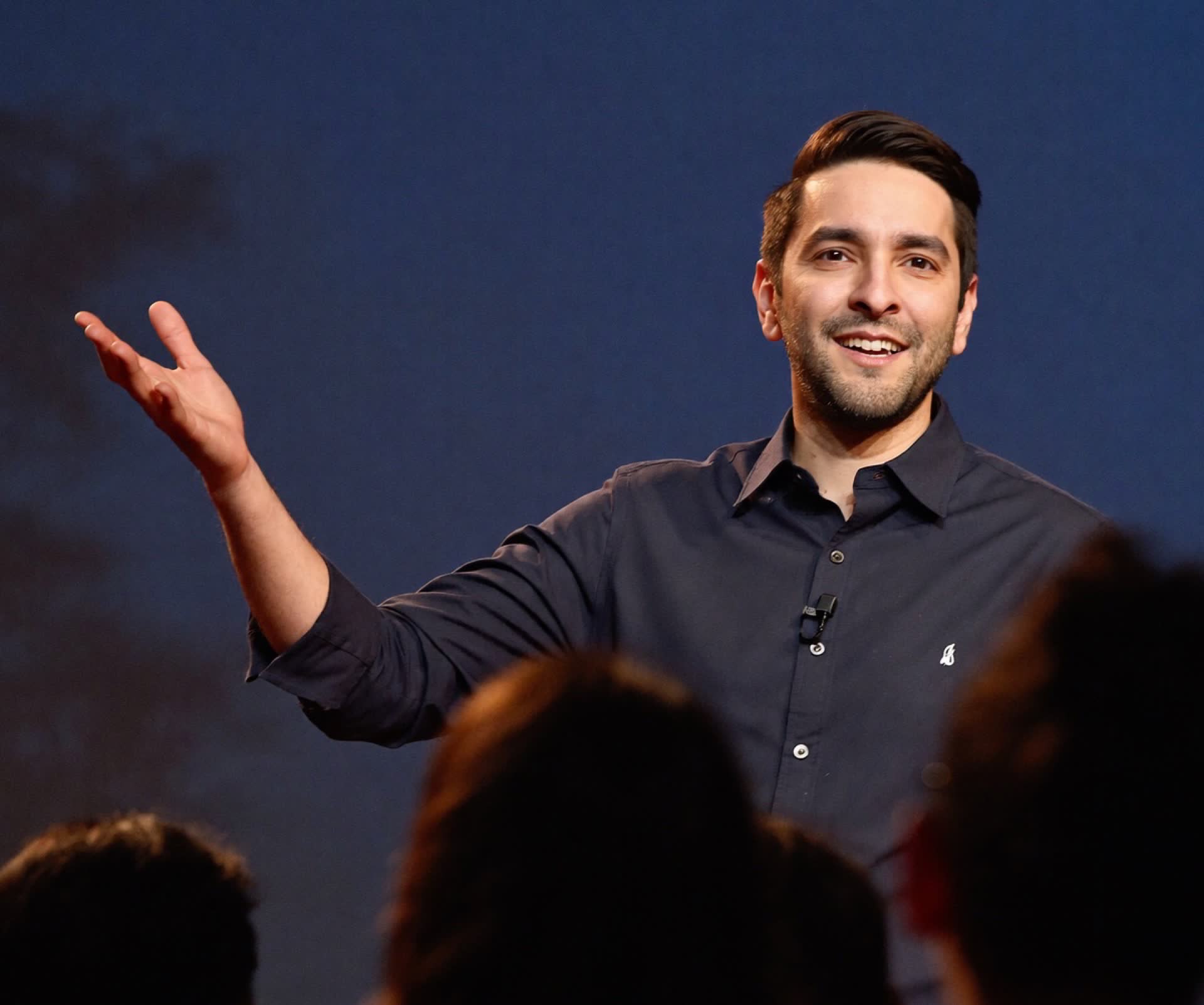
Hashim Syed studied politics, philosophy and economics — and now leads AI go-to-market for startups at Google. He unpacks what actually separates AI winners from AI slop, why open and closed models both need to exist, and where the real work sits before AGI arrives.
A PPE graduate inside a model lab
Muzamil opens this as a joint episode of Thought Behind Things and Beyond the Bubble, the AI-focused series he co-hosts with Noodle Seed Studios in San Francisco. The framing of that series — AI is inside a financial bubble but the underlying technology is genuinely rewiring economies — sets the tone for the entire conversation.
Hashim Syed’s path is the first thing Muzamil pulls at, because it does not look like a typical big-tech AI résumé. Born in London, raised partly in the Netherlands, with deep roots in Pakistan, Hashim studied politics, philosophy and economics. “I was not technical,” he says plainly. What he did have was a builder’s instinct and an early frustration with the standard career funnel: “I hated this idea when I was a student that you need experience to get experience.”
He started a consulting firm as a student, interned at EY, did ten weeks at JP Morgan, then turned down the banking track — which, as he notes, “if you come from a South Asian household or from Pakistan, that’s a big thing.” Meta came next, then a co-founded fitness app in the UK called Magic Mountain that raised institutional money and had a small exit, then Microsoft in financial services sales, a brief entrepreneur-in-residence stint at Antler, and finally Google, where he has now been for four and a half years. He started in London on search product strategy, was picked for a special project in San Francisco, and now sits on a team that does go-to-market specifically for DeepMind, working with founders from seed to Series A on Gemini.
Muzamil pushes on why Google has kept a self-described restless builder for that long. Hashim’s answer: “I love what I do. I feel it’s one of the greatest privileges to be in this unique position where you’re in a model lab working model lab and helping founders apply their technology.” He also admits, without hedging, that he expects to be back building at some point.
The new rules of growth
When Muzamil asks how the AI narrative has shifted from the doomsday phase of 2023 into today’s more cautious optimism, Hashim reframes the question around what he calls the new rules of growth.
The headline claim is stark. In the cloud era, companies had five to seven years to reach $100M in ARR. In this AI-native environment, tools like Cursor, Replit and Lovable have hit that same scale in five to seven months. But so has the differentiation problem: “It’s never been easier to scale, but it’s also never been it’s more now more difficult to maybe perhaps differentiate yourself.”
From that he extracts three themes. First, real activation over fanfare — and here he borrows a line from Lovable that Muzamil visibly likes: “You don’t need a minimal viable product, you need a minimum lovable product.” Second, efficiency is now table stakes; the startups actually winning are re-engineering end-to-end processes with orchestrated teams of agents, not shaving minutes off document creation. Third, governance and education are the enablers. Gemini Enterprise, he notes, is now live in 90% of Fortune 100 companies, but the question he gets most often is not about the model — it is how to make people on the ground AI-fluent.
Cursor is the exception, not the goalpost
Muzamil pushes back. Tools like Cursor and Lovable grew rapidly partly because they were riding a wave and partly because they had to be simple enough to capture the lowest common denominator. Real value, he argues, is customised and niche — and the kid in a basement targeting “the next Cursor” is aiming at the wrong goalpost. If that same builder targeted $50,000 rather than $60 billion, there is very real value to be captured.
Hashim agrees the outliers are outliers, and borrows Bessemer’s framing of two company shapes: supernovas that hit $40M ARR in year one and $200M by year three, and shooting stars that follow a more typical SaaS curve — $3M, then $12M, then $40M. What his team actually tries to do, he says, is pull founders back from the hype cycle. The companies that last build “differentiated modes through the data that they have,” clear workflow orchestration inside the environments they deploy into, and predictable token unit economics.
He grounds this in his Magic Mountain experience: raising money but refusing to burn on ad dollars, showing up at gyms with flyers, chasing B2B partnerships with Deliveroo, KPMG and F45 rather than paying to acquire customers who would churn.
Getting started when you don’t have a credit card
Muzamil widens the lens to Pakistan, and to the very concrete problem of a kid who wants to build with AI but does not have a credit card, let alone a cloud budget. Hashim points to two things Google has been doing on the ground.
The first is Gemini Enterprise inside Pakistani companies — a fellowship programme run across late 2024 and 2025 with Googlers from Singapore and elsewhere, providing licences, training and a safe entry point for AI in the workplace. The second is a nationwide vibe-coding competition that, by his account, trained close to 100,000 people, with builds spanning health-tech, ed-tech and fintech.
His advice to any newcomer is disarmingly practical: “Just talk to it. Just literally press the voice icon, describe who you are, what you do and what you’re stuck with, and ask it to teach you.” That, he says, is exactly how he learned — asking a model in early 2025 what an agent was, what an MCP server was, what system instructions to write. Then he lands the line Muzamil lets sit: “You can outsource intelligence, but you can’t outsource understanding.”
Are BPO economies about to be automated away
Muzamil raises what is arguably the hardest question for the developing world. Pakistan, India and the Philippines have built large services economies on exactly the kind of back-office work that agents are best at replacing. Is that era sunsetting?
Hashim resists a clean prediction and reaches for historical analogy. Before the internet, there was no such job as social media manager or digital marketer. The 2000s and 2010s produced entire new industries — data science, measurement, analytics — off the back of the internet age. He believes AI is doing the same thing now, citing a roughly thousand-percent year-over-year growth in AI-related roles.
His more interesting argument is structural. A market like Pakistan — which he describes as the world’s third largest exporter of IT freelancers — is in a better position to become AI-native than a market with no technical base at all. “The learning gap for a non-technical person to become an AI builder versus somebody who has the technical skills to write code is much easier on the second.”
He also flags a counter-current: AI labs are hiring storytellers, content managers and people with strong human skills, precisely because the flood of AI slop has raised the premium on humans who can articulate what is actually happening. His own job, he reminds Muzamil, did not exist three years ago. He went and found it.
Open source, closed source, and why Google runs both
Muzamil lays out the open-versus-closed debate carefully, giving both sides — frontier labs worried about bioweapons and cyber risk, open-source proponents worried about power concentration and pricing out the developing world. He notes how competitive pressure from models like Kimi has already pushed frontier lab pricing down.
Hashim’s answer is that this is not a binary. Frontier models — Gemini, Claude and others — are pushing the ceiling on reasoning, multimodality, context and enterprise-grade security. He returns repeatedly to Demis Hassabis and the DeepMind team, arguing that multimodality is non-negotiable because humans do not work in text alone. But developers also need open-weight models like Gemma to run locally, fine-tune, and keep data private.
Muzamil presses on the economic logic — why would Google offer both? Hashim compares it to Android. There are genuinely two use cases: edge and customisation for developers, and enterprise cloud orchestration for large customers. He also points out that Google runs Anthropic’s models on its own infrastructure and, on some benchmarks, serves them faster than the alternatives. The strategic bet is to be the interoperable hyperscaler — “we want to be your partner of choice as you scale through the entire stack” — a philosophy he traces back to Sundar Pichai’s 2016 IO keynote framing Google as AI-first.
Tokenomics and the agentic bottleneck
The conversation on models moves naturally into cost. Hashim describes Gemini as sitting on the Pareto frontier of price-to-intelligence, with Flash and Flash-Lite models tuned for cheap, fast inference. But the deeper point is that customers of every size — seed startups through trillion-dollar enterprises — are now having serious conversations about which model to route which task to. CIOs and CTOs, he says, are trying to align the right model to the right workflow and the right user, rather than defaulting to the most expensive frontier option for everything.
He then flags shadow AI as the quiet enterprise risk — employees using unlicensed AI tools and leaking proprietary data into public models. Muzamil sharpens the point: at least one major provider, he notes, trains on every prompt, which means enterprises are effectively training the models that will disrupt them. Hashim’s response is a concrete workflow recommendation. For hobby prototyping, use Google AI Studio. For anything inside a company environment, use Agent Platform (formerly Vertex AI) — a sandboxed, enterprise-grade environment where the data stays yours.
The token conversation then loops back to agents. “Token cost is somewhat the agentic bottleneck,” Hashim argues. Multi-agent systems running 24/7 consume quadrillions of tokens, and using peak frontier models for every sub-task is uneconomical. His mental model is a human team: a manager agent on a strong model, ICs on lighter models, each specialised. That, he thinks, is where 2025 and 2026 are heading — vertical AI maturing, then AI operating systems connecting disparate tools, then physical AI in factories, farms and vehicles.
The data-in problem the developing world hasn’t solved
Muzamil offers his own reduction of AI: data in, processing or decision, insight out. The problem, he argues, is that San Francisco is operating on a completely different frequency from the rest of the world. Even in Atlanta and much of the US East Coast, most people he speaks to are still just “using ChatGPT.” In Pakistan, Indonesia and India, the deeper issue is that the data-in layer simply does not exist. Digital transformation is still ongoing. AI transformation is being layered on top of a foundation that was never fully built.
Hashim reaches for The New Rules of Geography, a book he is reading, and for the biological analogy: artificial neurons mimic biological ones, and AI systems perceive, reason, understand and output in a way that echoes how humans work. He acknowledges the data-capture gap is enormous, and argues it will get solved partly through synthetic data and partly through embodied capture — robotics and self-driving cars like Waymo building new intelligence layers as they move through the world. He is also clear on why localisation matters: models like Gemini Live that speak local languages fluently, grounded in local nuance, are how AI actually gets democratised.
His closing note on this thread is philosophical. Whatever a model gives you, question it. “Anything that anyone says — I was taught in philosophy — you should question it, critically analyse it and assess it. And that should still be the case with any output of any AI generated model.”
Prepared to go slower so the world can catch up
Muzamil ends by asking Hashim to take off the Google hat and put on the philosophy-and-economics one. Where does AI take us fifty years out?
Hashim admits five years is already hard to predict. But he sketches three things. First, physical AI will be embedded in daily life — humanoids, autonomous vehicles, smart homes where you simply talk to the house. Second, there is a real risk that in the rush to train people on technical AI skills, the world under-invests in the durable human skills — empathy, critical thinking, leadership, taste. Third, adaptability. His own trajectory from PPE lectures on Machiavelli to leading AI GTM was not planned. It was found.
Muzamil then lays out the three camps he sees in the AI debate: the short-to-medium-term doomers focused on disruption, water and energy; the heads-down innovators; and the long-horizon maximalists who point to the exponential curve of GDP growth over the last two thousand years and argue AI is the only path to solving problems like water scarcity at scale. He offers a sharp example — a LinkedIn post from someone who builds AI agents but publicly opposes data centres in Pakistan — as the kind of dichotomy the conversation needs to move past.
Hashim’s closing frame has three parts. First, simply scaling up text-guessing transformers will hit a ceiling; the next breakthroughs will come from world models — he name-checks Fei-Fei Li’s work and DeepMind’s Genie — that understand physics and spatial logic. Second, deep-thinking agents are being given more compute time to internally simulate options; humans should be doing the same when confronted with a problem. Third, he lands on optimism, pointing to AlphaFold as the kind of breakthrough mainstream coverage misses while it obsesses over chatbot benchmarks.
The line Muzamil clearly registers is Hashim quoting Demis Hassabis at Davos, sitting next to Dario Amodei: “I’m prepared to go slower if it means the world can catch up.” Hashim’s own version of this is the one he leaves the audience with — that whatever gets disrupted, more will be built on top, and the transitionary period is what actually deserves the attention.
Muzamil closes by turning to the audience: are you a doomer, or an AI maximalist expecting a workless heaven on earth? Hashim’s answer, without ever quite saying so, sits somewhere in the middle — technically fluent, philosophically restless, and unwilling to let either camp off the hook.


Never miss a conversation.
New episodes and the thinking behind them, straight to your inbox. No hype, no spam, no pitch.