Thought Behind Things
The surgery that could end Muzamil's career
In episode 257, Muzamil Hasan sits on the guest side for the first time in over 100 episodes to explain why TBT is going on a break — and to share a medical diagnosis that could permanently change his ability to speak.
The table turns
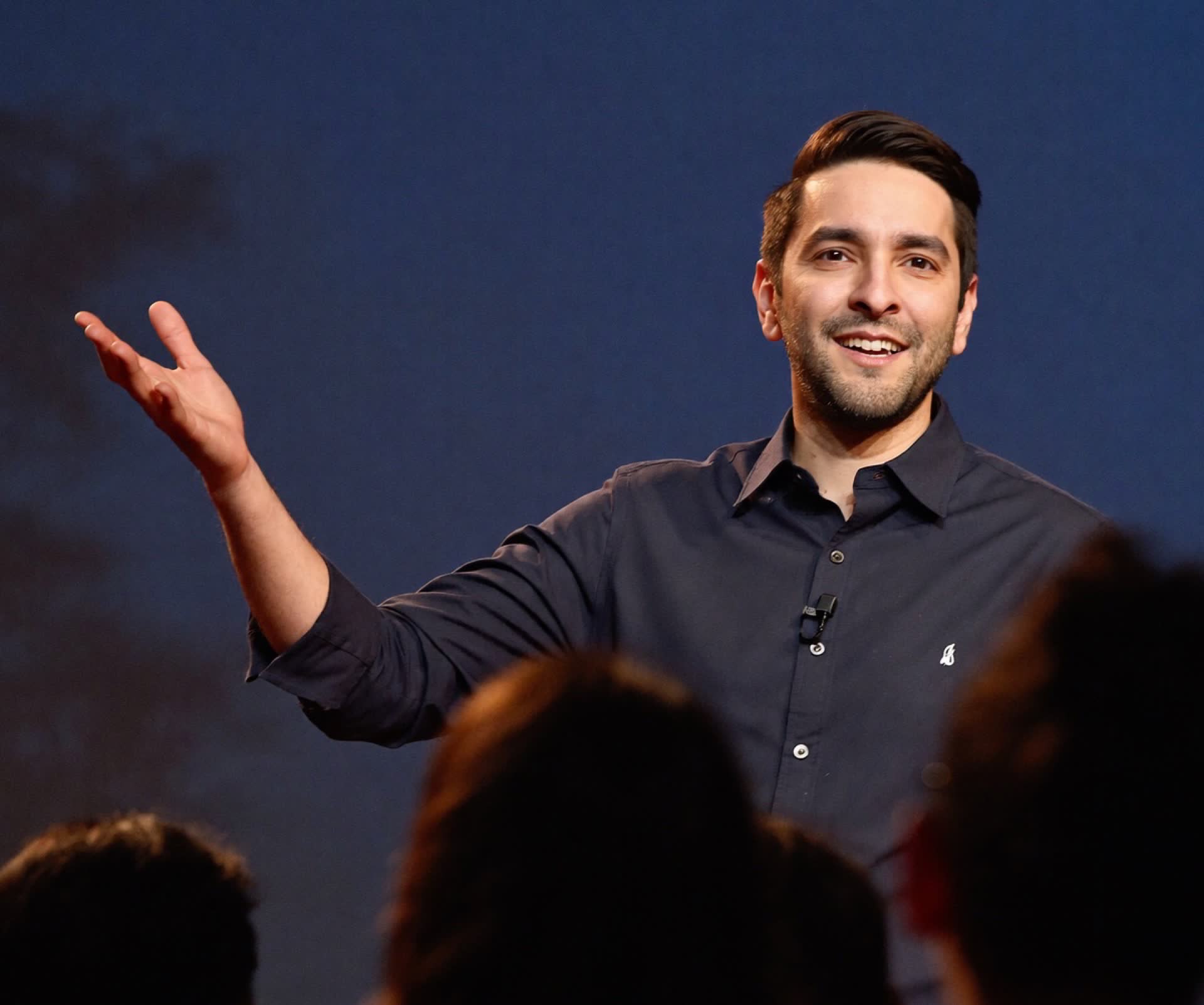
The episode opens with an unusual scene. Yusra Murtaza is in the host’s chair, and Syed Muzamil Hasan Zaidi — the man who has sat across from 256 guests — is on the other side of the table. The title of the episode, Ending TBT?, has already unsettled the audience. Yusra acknowledges this immediately: there is a special announcement, and that is why the beloved host is today’s guest.
Muzamil admits he is excited but slightly disoriented. “I haven’t been on this side of the table for only 200 episodes,” he says, noting that the last time Yusra hosted him, the audio was broken because the microphone was facing the wrong way. This time, at least, the setup is right.
A room that holds everything
Before the announcement, Yusra walks Muzamil through his early life — a recap for newer listeners. He was born in Saudi Arabia, moved to Lahore at age one, and eventually settled in Islamabad in 1992 when his father joined Askari Bank as one of its founding employees. The family lived in a rented house for two years before buying the home where Muzamil still lives today.
What makes this section land is a detail about the very room in which the podcast is recorded. Muzamil points out that directly behind where Yusra is sitting, there used to be a bunk bed. His entire family — mother, father, four siblings, and a grandmother with Alzheimer’s — lived in that single room for years. “My entire childhood was in this room,” he says. “I moved out of this room when I was 14 years old.” The podcast studio, in other words, is also the room where he grew up. It is, as he puts it, a circle of life.
From time-lapses to CNN at 25
Muzamil’s content career began before university. He took a year off in 2010, started photography, and launched Loj Studios in 2012. One of his earliest pieces was what he describes as the first digital time-lapse of Islamabad — still on his channel. In 2013, ahead of Pakistan’s elections, the studio produced a campaign to encourage voting, which reached, by their own research at the time, one in three Pakistanis on Facebook.
The real inflection point came in 2015 with the Paris attack video. The video used John Lennon’s Imagine to push back against the painting of all Muslims as complicit in terrorism. It went viral primarily in Europe. Reuters picked it up. CNN called. Yoko Ono’s representatives reached out to say she had seen the video and that it captured exactly the feeling she had intended when she wrote the song. Muzamil was 25 years old, receiving pictures from airports and restaurants across South America and Africa from followers who had spotted him on television screens mid-flight.
“It’s like in the movies,” he says, describing the moment a CNN producer counted him down live on a Skype call with satellite feeds stacking up in his requests.
The crash nobody warned him about
What followed the Paris video is the part of Muzamil’s story that most of his current audience does not know. He went quiet. He left social media. And the reason, he explains, was a combination of factors that nobody in Pakistan’s nascent creator industry was equipped to help him navigate.
The first was a creative identity crisis. If content could connect people across continents, he could not justify going back to comedy skits. But the Pakistani audience at the time had not evolved to the point where the kind of content he wanted to make would find traction. The second was the industry itself: YouTube was banned in Pakistan, short-form content was exploding, and creators were reaching a million subscribers in two weeks while he had spent six years building something with no monetization model. His father told him media was unsustainable. He had no case studies to push back with.
The third was depression. “Every creator’s first wave, when it crashes, they go into depression,” Muzamil says. “When you rise, you get this ego boost. And then when your peak passes and you don’t know what to do, there is nobody to tell you what the next step is.” He is careful to note that he is not blaming anyone — the industry was too young, and there was simply no one above him who had been through it.
He left, tried a smart-homes startup (installing security cameras and running wires himself), watched it fail, went to the US for five months to reset, came back, and joined Teradata as a data analyst — the career he had originally planned before digital media took over. He stayed roughly two years, then spent a few months as head of digital marketing at NDPL, before concluding that he did not have the temperament for a nine-to-five and that his strengths could not be confined to a single specialized role.
Building the industry from behind the scenes
Between 2015 and 2019, while largely off social media as a creator, Muzamil was doing something less visible but arguably more consequential. He was studying the ecosystem — case studies, MIT and Harvard research, industry reports on India, Turkey, the UK, and the US — trying to understand why audiences consume certain things and let go of others, what sustainable content actually looks like as a business, and how monetization works at scale.
He was also helping set pricing for the industry. He describes building an algorithm that creators would call him to run: plug in your follower count, your engagement rate, and get a number. “In 2016, a big creator’s Instagram post sold for five thousand rupees,” he says. “In 2019, it was anywhere between one hundred and fifty thousand to three hundred and fifty thousand. Today it is four hundred thousand to one and a half million.” He did this work for free, understanding that if creators underpriced themselves, brands would conclude digital had no ROI, and the entire industry would stall.
He also began representing the industry in policy conversations. When Fawad Chaudhry, then information minister, announced incoming licensing regulations for digital platforms, Muzamil was brought in — through a chain that ended with Irfan — to represent creators at the consultation. His position was not reflexive opposition. He agreed that terrorism-related content, hate crimes, and incitement to violence needed regulation. His argument was that the framework should be targeted at those specific harms rather than a blanket policy that would crush a 16-year-old girl from a small city before she had a chance to grow.
The most visible outcome of this period was the January 2020 prime minister meetup. Muzamil’s logic was simple: the older generation did not take the creator industry seriously because they had never seen a prime minister take it seriously. “If the prime minister is taking you seriously, then everybody will,” he says. The group photo from that meeting was engineered deliberately — modelled on the Oscar selfie, intentionally raw and slightly crooked — because the imagery of a prime minister sitting informally with content creators, rather than in a formal posed shot, was what would travel. It did.
Later in the discussion, Muzamil describes coordinating an influencer network during COVID-19 at the request of Tania Aidrus and the Digital Pakistan initiative. Around forty to fifty million in combined following, pushing verified government communications directly to young audiences who were not watching television. No influencer charged a fee.
What TBT actually is
Yusra raises the question of numbers. TBT has just crossed 200,000 subscribers. Some episodes do 15,000 views. By the standards of the creator economy, these are not shiny figures. Muzamil is unbothered, and his explanation is worth sitting with.
“The most important thing in life is respect,” he says, attributing the line to his mother. “I would rather have a respectful 200,000 audience than a disrespectful 10,000,000 audience.”
His argument is structural. The audience TBT has built skews toward people who are already influential in their own right — early professionals, founders, people in positions where they can make structural decisions. “You could have 40 people watching you, or one CEO. That one CEO can bring a structural change that impacts the 40 and everyone below them.” The influence, he argues, is relative and contextual, and reducing it to a number tag is the same dehumanization he fell into in 2015.
He also describes the show’s original purpose: to build a catalogue of 1,500 top leaders. Not to generate revenue. Not to hit subscriber milestones. “We never even sent a tweet when we hit 100k,” he says. The play button arrived and they went to lunch and came back and did not post about it.
The humanization argument runs through everything. TBT’s long early-life sections — which some viewers find slow — exist because by the fortieth minute, the audience knows the person sitting in front of them well enough to trust what they say next. “That person was telling the truth before, and they are telling the truth now,” Muzamil explains. “Before, you thought they were just a brand.”
The surgery
By the end of the conversation, Yusra asks the question the title has been holding: why are you shutting it down?
Muzamil clarifies that TBT is not being shut down. It is going on a two-month break. The reason is a medical procedure.
He has a vascular malformation in his mouth. It is rare. It is large. If left untreated, it will grow until it suffocates him. The treatment requires surgery under general anaesthesia — cutting it open and extracting it. There are potential complications, he says, that could be “at the very least, career changing effects.” The irony is not lost on him. “My job is speaking. Out of all the places.”
He is matter-of-fact about it. The episode will most likely go live after the surgery has already happened. If things go well, TBT will return in the first week of September. If they do not, the team will figure out how to continue the mission without him. “TBT is a brand bigger than me,” he says. “It’s a vision beyond Syed Muzamil Hasan Zaidi.”
Yusra does not push him to perform optimism. She acknowledges that it must be hard on his mental health, that speaking has always been his thing — TBT or not — and that she hopes the recovery is smooth. Muzamil’s response is quiet. He says he is a believer in karma and manifestation. He says alhamdulillah, it has worked so far.
Pakistan in 2050
In the final stretch, Muzamil offers his read on where Pakistan is headed — the question he has asked every guest across 257 episodes, now turned back on him.
His framework is built on access to information. Internet has given people the ability to understand budget documents, petrol price mechanisms, and governance failures in ways that were impossible a generation ago. He describes meeting a 50-year-old police constable in a village who gave him a step-by-step breakdown of how international commodity prices and COVID had driven inflation. The constable had learned it on TikTok.
“A lot of the problems in Pakistan today are not problems that Pakistan is suddenly facing,” Muzamil says. “They are problems that we, for the first time, are beginning to talk about. And when you do that, the solution is inevitable.”
On politics, he is deliberately neutral on personalities but pointed on structure. The two-party system, he argues, is not democracy — it is two family dynasties with horsemen who flip between them. But he points to India as evidence that populations, given access to information, eventually reject what is not working for them. The floodgates, he says, have been opened. The public is no longer willing to sit silently.
On overseas Pakistanis, he reframes brain drain entirely. Pakistan’s human capital export generates $30 billion a year in remittances — larger than the textile industry. “We should see the people moving abroad as a definitive industry,” he says. “Call it a human capital industry.” The goal should be to design programs that maximize that export while ensuring local supply keeps pace, not to attach guilt to people who leave.
His 2050 prediction: no water crisis, no food crisis, a Pakistan that is well-integrated into the world, exporting products and services, and playing a meaningful role in regional and global policy. He grounds this in demographics — aging populations in Europe and China, a young English-speaking workforce in South Asia, and a century of Asia that is, in his words, “110% inevitable.”
He ends where he began: with data. “As a data analyst, you cannot fight data.”


Never miss a conversation.
New episodes and the thinking behind them, straight to your inbox. No hype, no spam, no pitch.